

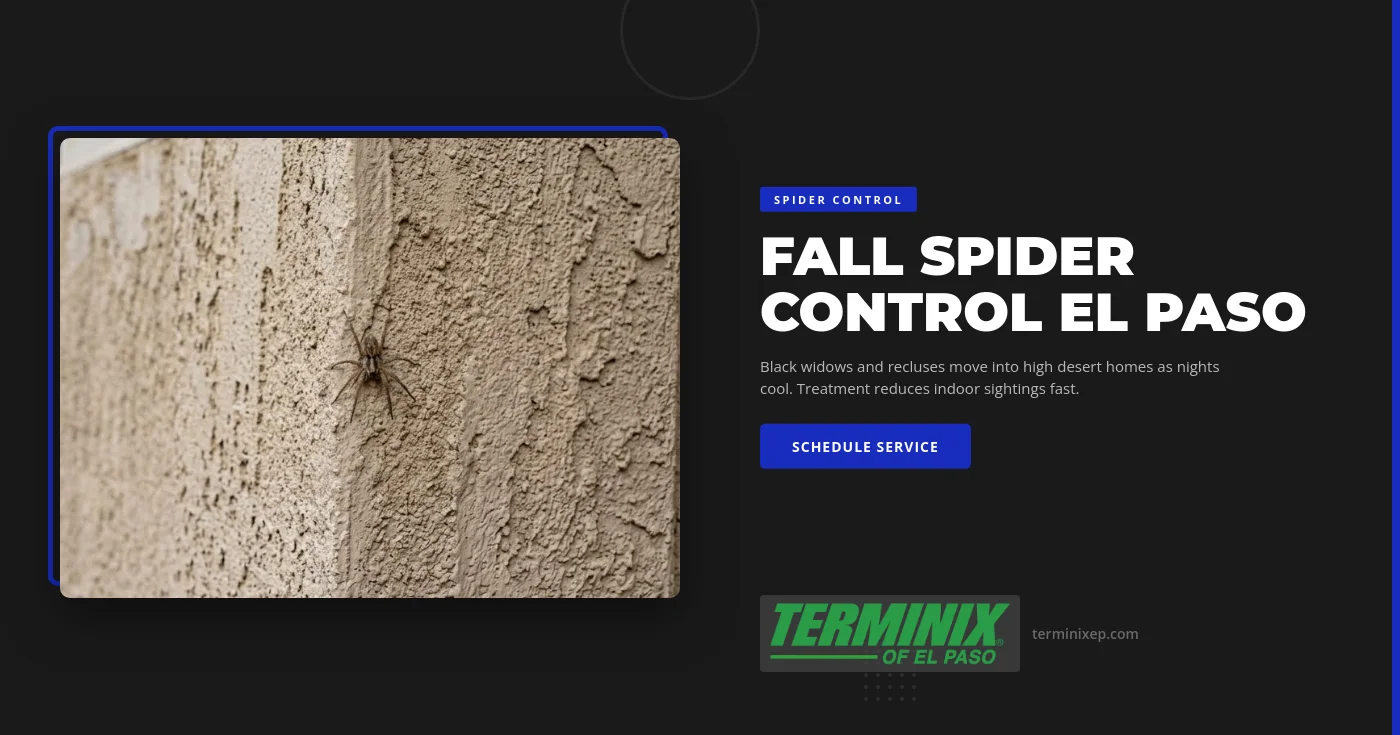
The first week of real fall weather in El Paso is also when we start fielding spider calls in volume. As overnight lows slide into the 50s and 60s, the invertebrate prey that western black widows and recluse spiders rely on thins out, mating pressure peaks, and both species push into garages, patios, and the quieter corners of the house. That is why October and November are the busiest months for spider control in El Paso, TX, and why a fall perimeter treatment is the highest-value spider job most borderland homeowners run all year.
At Terminix El Paso we work homes across El Paso, Socorro, Horizon City, Canutillo, Sunland Park, and Fort Bliss. Below is what we walk every fall caller through: why spider activity jumps when the weather turns, which two species carry a real medical bite in the borderland, where they actually hide, what homeowners can handle themselves, and what professional spider control looks like when the DIY ceiling is reached.
Three things shift when a Chihuahuan Desert fall arrives, and all three push spiders toward structures.
Temperature is the first lever. Western black widows (Latrodectus hesperus), the dominant black widow species across the far-west borderland, hit peak adult activity from mid-summer through October. These spiders stay active into cooler nights and seek out warmth as El Paso’s October overnight lows drop. Recluse spiders behave the same way, and the surface temperatures inside a sun-baked stucco wall or a stacked garage become the warmest, driest microclimate available after monsoon season ends.
Prey is the second lever. Spiders eat crickets, cockroaches, moths, and other invertebrates that themselves move indoors in the fall. If your late summer has already brought crickets along the baseboards or roaches in the garage, a spider surge trails that activity by two to four weeks.
Mating pressure is the third. Male western black widows wander in late summer and fall looking for females to mate with, which is why spiders spotted on a wall or inside the garage during October are disproportionately roaming males. Male recluses do the same thing a little later, into November. Both species run most actively between dusk and midnight — the first evidence of a problem is usually a web spotted on a morning walk-through, not the spider itself.
The western black widow is the only widow species we routinely confirm in the far-west borderland. Mature females are jet-black with a glossy, round abdomen about half an inch across and an unmistakable red hourglass on the underside. Juveniles can look striped or mottled with cream and brown — the solid black develops over several molts. Males are much smaller and often overlooked, though they wander more in late summer and fall.
Western black widows build irregular, tangled webs with heavy anchor lines close to the ground or against a vertical surface. On an El Paso fall inspection, the classic spots are:
The bite risk is real. According to the Texas Department of State Health Services, black widow bites can cause severe abdominal cramping, muscle rigidity, headache, nausea, profuse sweating, and tremors — symptoms serious enough to warrant medical evaluation, especially for small children, older adults, and anyone with a compromised immune system. The spider is not aggressive and typically only bites when crushed against skin — exactly what happens when a hand reaches blindly into a stored box or a boot is pulled on without being shaken out first.
Recluse spiders in the El Paso region are more complicated than widows. The recluse we find in the El Paso area is mainly the Apache recluse (Loxosceles apachea), documented through New Mexico and into Texas. Its close relative, the desert recluse (Loxosceles deserta), lives farther west in southern California, Nevada, and Arizona. Recluse species look and behave similarly and carry the same necrotic bite risk, so homeowners should treat any recluse-type sighting seriously.
Identification is specific. Recluse spiders are small — a mature body is only about three-eighths of an inch, with legs that stretch the overall span to about the size of a U.S. quarter. The color is uniform tan to light brown. Two features set them apart from the many harmless brown spiders in local homes: a dark, violin-shaped marking on the top of the cephalothorax (with the neck of the violin pointing toward the abdomen), and an eye arrangement of six eyes in three pairs instead of the eight eyes most spiders show. The UC Statewide IPM Program notes that the six-eye pattern is the single most reliable field marker.
Recluse spiders are classic hiders. They shelter under rocks and boards, in rodent burrows, inside pack rat middens, under fallen cactus skirts, among stacked wood, and inside anything that sits undisturbed for long stretches. Indoors, that translates to stored boxes in a garage attic, holiday decorations pulled out once a year, folded clothing in a seldom-opened closet, under baseboards behind furniture that never moves, and inside shoes left in a dim garage overnight. Bite symptoms, per Texas DSHS, include chills, fever, nausea, restlessness, weakness, and the signature "red, white, and blue" lesion at the bite site that can progress to tissue necrosis if untreated. Any suspected recluse bite warrants prompt medical evaluation.
Once the daytime temperature stops hitting the 90s, both widows and recluses expand their indoor footprint quickly. The specific spots we check on every fall inspection in the borderland:
On a fall inspection we work the house as a system — exterior perimeter first, then garage, then interior transition points, then rooms occupied least.
Before any professional treatment, a short list of homeowner steps genuinely moves the needle on fall spider pressure. We ask every caller to run these before our technician arrives, because the environmental changes make the chemical work last longer.
Done consistently through October, these steps measurably reduce how many spiders find the house and extend how long any professional perimeter treatment holds.
When DIY measures are not enough — or when a confirmed widow or recluse sighting raises the stakes — a professional treatment plan is the right call. Our Terminix El Paso spider protocol works the home as a system.
Every technician on our spider crew is licensed for the border region, and every treatment is built around the well-being of children, older adults, and pets at home.
A single harmless spider in a corner is not a reason to call. The thresholds that warrant a professional spider control response: two or more confirmed widow or recluse sightings inside the home within two weeks, any bite with the symptom pattern described above, visible egg sacs in a frequented area, repeated web rebuilding in the same spot after cleanup, and any confirmed harborage in a garage or shed that children or pets can reach.
Reach out to our Terminix El Paso team as soon as the first two thresholds are met. A fall inspection in October is dramatically less disruptive than a January emergency after a bite — and the fall perimeter treatment protects through winter and into the next spring surge. We are local, we know the borderland species, and we build every spider control job with peace of mind for the family and gentle care for pets. Let us close your El Paso property to black widows and recluse spiders before the next cold front sends the rest of the season's population indoors.
 Mon – Fri: 8:00 am – 5:00 pm


