

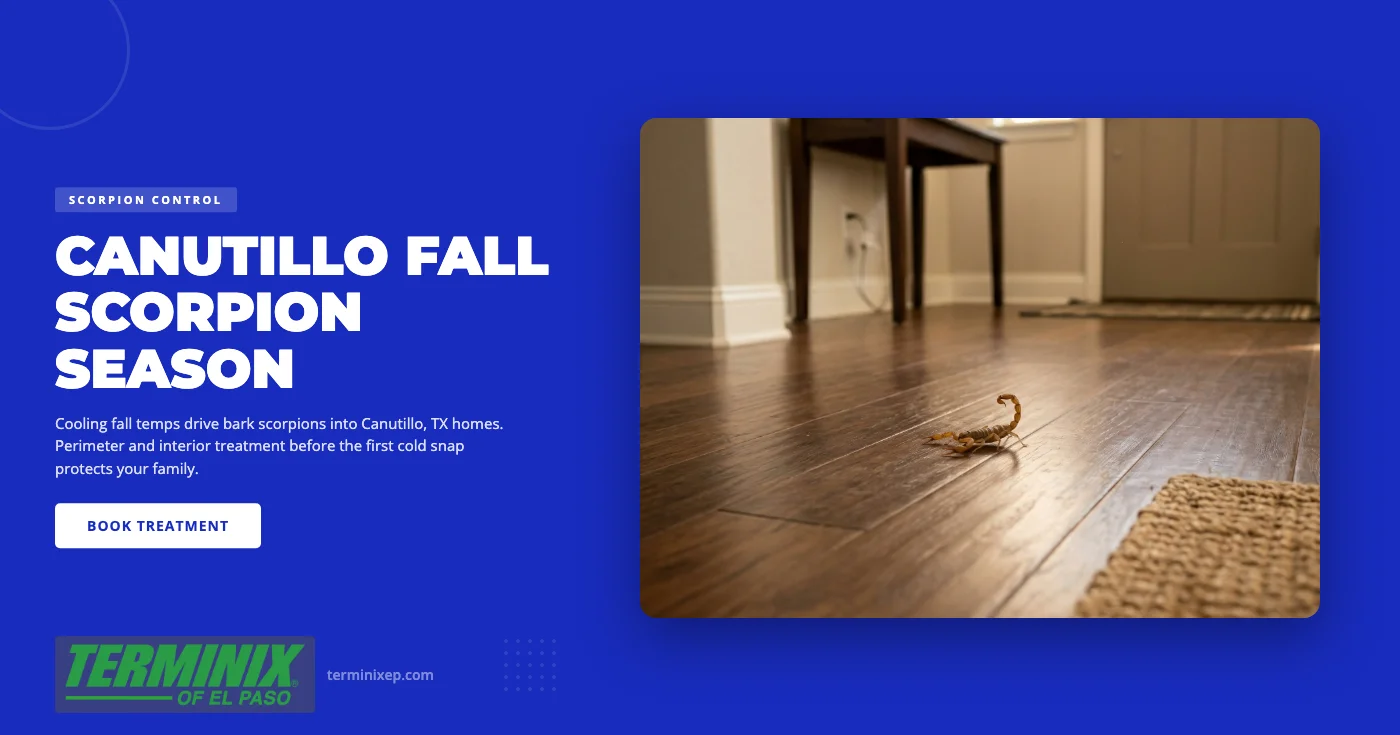
Canutillo's early-fall calm can be misleading. The pests that dominated summer — crickets, roaches, spiders — thin out as temperatures fall from the mid-90s in August into the mid-70s by mid-October. But that same cooling curve is exactly what wakes up scorpion activity inside homes across the Doniphan Road corridor. From the last week of September through the first freeze, we field a steady stream of calls for scorpion control in Canutillo, TX as bark scorpions shift from outdoor rock piles and yard debris into garages, bathrooms, and bedrooms.
At Terminix El Paso we serve homes throughout Canutillo, El Paso, Socorro, Horizon City, Sunland Park, and Fort Bliss. Below is what our technicians walk homeowners through every fall: why the desert climate pushes scorpions indoors when temperatures drop, where they hide once inside, which species pose the biggest risk in West Texas, and the sealing steps and treatment plan that stop an infestation before children, pets, or an unwanted midnight surprise are in the mix.
Scorpions are cold-blooded. They cannot generate their own body heat, so their behavior is dictated by the temperature of their surroundings. During Canutillo's peak summer, outdoor daytime highs regularly push past 95°F while nights hold in the 70s — perfectly suited to nocturnal hunting on desert rock piles, in cracked adobe walls, and under woodpiles. As September rolls in, that comfort window shrinks. Daytime highs slide toward the mid-80s and, more importantly, overnight lows begin dipping into the low 60s and eventually the 50s.
Those cooler nights push scorpions to look for warmer, more stable shelter. The interior of a Canutillo home holds a steady 70 to 78°F all fall — exactly the temperature range where a striped bark scorpion stays active enough to feed and slow enough to conserve energy for winter. Add in the availability of prey (roaches and crickets that themselves migrated indoors) and drying outdoor water sources after monsoon rains taper off in mid-September, and the environment inside becomes more hospitable than the yard. A leaky garden hose against a stucco wall, a dripping bathroom faucet, or a laundry room with high humidity is enough to draw a scorpion through a nearby crack.
Scorpions are nocturnal and shy of open space. Once inside, they wedge themselves into narrow, dark, humid harborage during the day and emerge at night to hunt. A Canutillo home built for the desert climate — thick stucco walls, tile floors, wide weep holes for brick facing, and an attached garage — creates several predictable hiding spots.
Older Canutillo homes near Doniphan Road and newer builds off Talbot Avenue share the same vulnerable architecture: exterior stucco and brick facing with functional weep holes at the base of the wall, deep window sills, and irrigated landscaping right up against the foundation. That combination is inviting to a bark scorpion looking for a fall refuge.
West Texas hosts several scorpion species, but two matter most to Canutillo homeowners.
Striped bark scorpion (Centruroides vittatus). This is the scorpion nearly every Canutillo family encounters. Adults reach about 2 to 2.5 inches long, are yellowish tan, and carry two distinct dark stripes down the abdomen with a triangular dark mark on the head. According to Texas A&M AgriLife Extension, it is the most widely distributed scorpion in the state and readily enters homes, attics, and outbuildings. Its sting is painful and produces local swelling, itching, and burning that can last several days — but it is not considered lethal to healthy adults. Reactions are more severe in small children, older adults, and anyone with an allergy or existing medical condition.
Arizona bark scorpion (Centruroides sculpturatus). This species' range extends into the far western tip of Texas, including parts of the El Paso and Canutillo area near the New Mexico state line. It is smaller than the striped bark scorpion (typically 2 inches or less), light tan without prominent stripes, and delivers the most medically significant sting of any U.S. scorpion. Stings can cause intense pain, numbness, muscle twitching, and — in vulnerable individuals — respiratory difficulty. Any suspected Arizona bark scorpion sting on a child or elderly family member warrants a call to poison control and emergency medical services.
Reliable identification takes a trained eye — the two species overlap in color and adult body length. Our technicians walk each property at dusk with a UV flashlight (scorpion cuticle glows blue-green under UV), locate the harborage, and match specimens to the Texas A&M identification key before setting a treatment scope.
The most effective scorpion control in Canutillo, TX is a home the scorpion cannot enter. Five prevention steps handle the majority of fall entry points:
A single scorpion sighting is manageable with sealing, decluttering, and a careful home inspection. Several signals, though, tell us a household needs professional support:
Professional treatment combines an exterior perimeter application, targeted interior crack-and-crevice product placement, harborage removal, and follow-up UV inspections at the two- and six-week marks. Each step closes a gap consumer product cannot cover on its own.
Every desert community has its own scorpion pressure profile, and Canutillo's is shaped by three specific factors: proximity to the Rio Grande and its irrigated agricultural corridor, the mix of older adobe-style homes near Doniphan Road with newer stucco builds off Talbot Avenue, and the way monsoon runoff pools along the base of the western foothills. Our team calibrates our fall treatments to those patterns. We know which neighborhoods run heavier on striped bark scorpion pressure, where Arizona bark scorpion sightings cluster, and which stucco builder patterns tend to have the widest weep holes.
Local experience is also what makes follow-up work. UV inspections at two and six weeks catch late-hatching offspring and any harborage the first pass missed. Interior treatments account for the ways families actually live — where kids leave shoes overnight, which rooms hold moisture, which garage corners never get cleaned out.
With a 4.9-star rating across 240+ reviews, our team serves Canutillo, El Paso, Socorro, Horizon City, Sunland Park, and Fort Bliss. Visit Terminix of El Paso to schedule a fall scorpion inspection before the first cold snap sends the outdoor population looking for a warm harborage in your home.
Indoor sightings peak from late September through early November. That window matches the point when overnight temperatures drop into the low 60s and 50s and outdoor prey thins out. A smaller second spike sometimes shows up in early spring when scorpions emerge from winter dormancy hungry and mobile.
The striped bark scorpion — the species most Canutillo families encounter — delivers a painful sting with local swelling that lasts a few days but is not considered lethal to healthy adults. Small children, older adults, and pets can react more severely, and Arizona bark scorpion stings require immediate medical attention for children and elderly family members. Any sting on a child under six warrants a call to a physician or poison control center.
Yes. Scorpion cuticle glows blue-green under ultraviolet light — a trait even hatchlings display. Our technicians walk the interior and exterior of a property at dusk with a 395-nanometer UV flashlight during every inspection, which reliably locates specimens that daytime visual searches miss.
An initial fall treatment typically holds through winter dormancy. Our standard plan includes two-week and six-week follow-ups to catch late arrivals, plus a spring refresh before the outdoor population becomes active again. Households with heavy pressure often move to a quarterly maintenance schedule.
Yes — Canutillo is part of our regular Doniphan Road corridor service area. Our technicians cover Canutillo, El Paso, Socorro, Horizon City, Sunland Park, and Fort Bliss. Schedule scorpion control in Canutillo, TX with our team before the first cold front sends outdoor scorpions into your home.
 Mon – Fri: 8:00 am – 5:00 pm


