

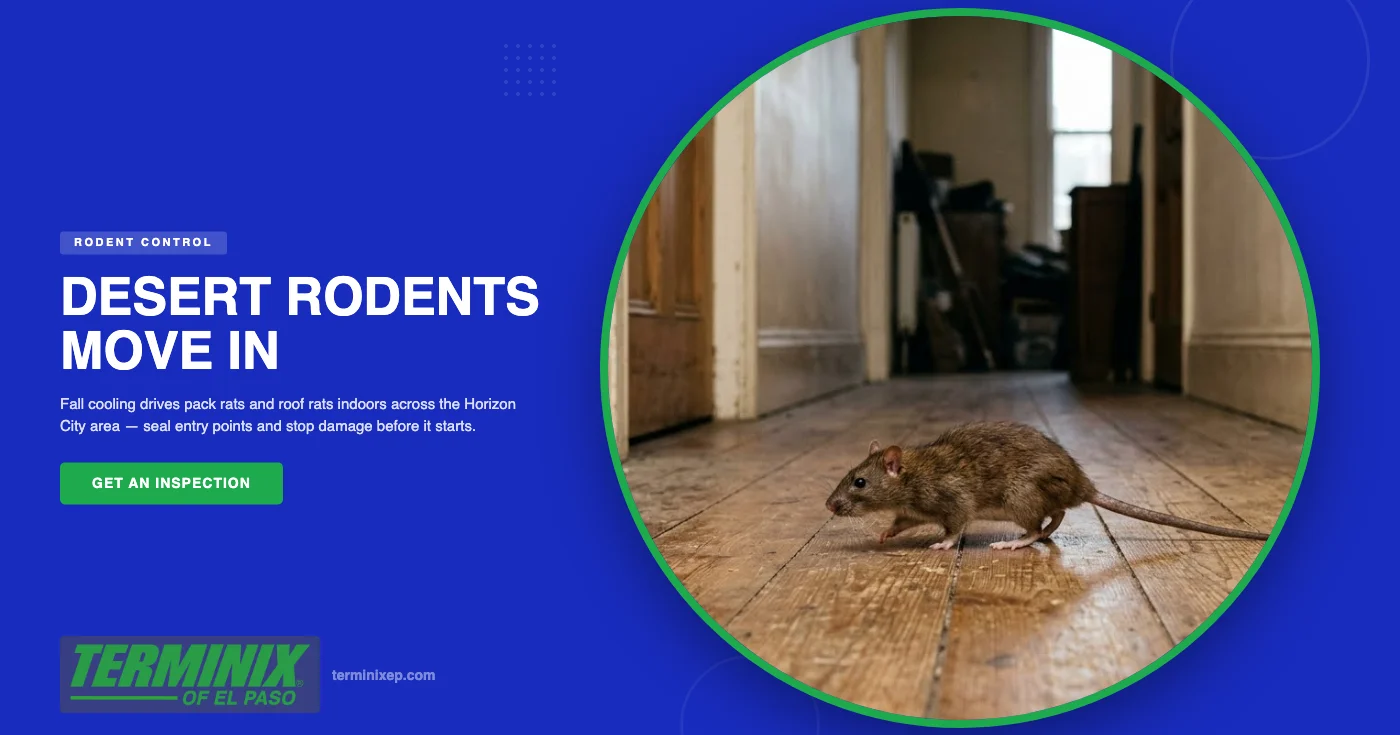
The first crisp mornings in Horizon City feel like relief after a long desert summer — but for pack rats, roof rats, and deer mice tucked into the mesquite around town, that cooling air is the cue to move. Once overnight lows drop into the 60s and then the 50s, wild forage shrinks and the steady 70-degree interior of a home starts looking like the easiest wintering spot for miles. That is why calls for rodent control in Horizon City, TX climb sharply from late September through November, and why the six weeks after the first cold front are the smartest window to close a home to a nesting colony.
At Terminix El Paso we serve homes across Horizon City, El Paso, Socorro, Canutillo, Sunland Park, and Fort Bliss. Below is what we walk every fall caller through: why cooling temperatures drive rodents indoors, which species we find in the borderland, how they get in, the warning signs, the CDC-flagged health risks, and the proofing steps that hold.
Three things converge in a high-desert fall, and they all pull mice and rats toward the nearest structure.
First, temperature. Pack rats, roof rats, and deer mice breed comfortably in a narrow band between about 65 and 80 degrees. Once October overnight lows slide into the 50s, an insulated attic becomes the warmest option within a mile — and one female can produce a litter of five to eight pups roughly every three weeks.
Second, food. The invertebrates and seeds that carry rodent populations through the warm months drop off sharply once nights cool. Cactus fruit ripens and falls fast, mesquite pods get picked over, and the insects that fuel deer mice quiet down. That drives rodents toward pet food bowls left on porches, chicken feed in garages, birdseed, dropped citrus, and trash cans staging overnight.
Third, moisture. Local summers ride on monsoon rain, and by late September that reliable water source disappears. Rodents track water aggressively in the fall, and a leaking outdoor spigot, a drip irrigation head near a foundation, or a poorly-sealed evaporative cooler line becomes a beacon.
The lag is what makes homeowners doubt the timing. A pack rat that moves into an attic during a mid-October cold snap does not announce itself — it builds a stick-and-debris midden, chews wiring into position for insulation, and stashes food. The first noise in the ceiling comes weeks later, often just before Thanksgiving. The trip inside started with October, not December.
Not every rodent story in Horizon City is the same, and the treatment approach depends on the species. Four show up in our fall route sheets more than any others.
We identify the species on every fall inspection because it changes where we search, what harborage we treat, and which entry points come first.
Once the temperature turns, rodents do not need much of an opening. A mouse gets through a gap the diameter of a pencil — about a quarter inch. A pack rat needs less than an inch. Every fall we walk homeowners past the same entry points around a typical Horizon City property.
None of these are complicated fixes on their own. The trouble is that a house has to be closed as a system — a single overlooked weep hole undoes the whole afternoon of caulk and hardware cloth.
Because pack rats and roof rats hide in the attic and wall voids, most homeowners never see the animal itself until the population is well established. What we teach every family to watch for through the fall:
Any two of these signs together justify a professional inspection. Waiting for the animal itself to appear usually means the fall population has already produced a second generation.
The health concern that separates desert Southwest rodent infestations from those elsewhere is hantavirus pulmonary syndrome. According to the CDC, the deer mouse is the primary reservoir species for the Sin Nombre strain of hantavirus in the western United States, and infection occurs when people inhale aerosolized virus particles from urine, droppings, or nesting material. The virus is not spread person-to-person in the United States, but the mortality rate for confirmed cases is high.
Two exposure patterns matter most for Horizon City homeowners. First, sweeping or vacuuming a shed, garage, attic, or storage closet with rodent droppings sends virus particles into the air — the most common exposure route in residential cases. Second, disturbing a nest during fall cleanup, weatherization, or holiday-decoration retrieval releases the same particles from a higher concentration of contaminated material.
What the CDC recommends, and what our technicians follow: ventilate the space for at least 30 minutes, wear an N-95 respirator, spray droppings and nesting material with disinfectant and let it soak for five minutes before wiping, never sweep or vacuum until the area is decontaminated, and double-bag all contaminated material. Beyond hantavirus, rodents also carry salmonella and vector the fleas that transmit murine typhus, which West Texas records every year. Small children, older adults, and anyone with compromised lung health should never do the cleanup themselves in a home with a confirmed infestation.
Trapping alone does not solve a fall rodent problem. Every rodent removed from an unsealed house is replaced by the next one looking for the same warmth and water. Our Terminix El Paso rodent-proofing protocol works through the home as a system.
Every technician on our rodent crew is licensed for the border region, and every treatment is built around the well-being of the family and pets living in the home.
A do-it-yourself trap or two makes sense for the first mouse in a kitchen. Once the signs point to an established colony — droppings across more than one room, scratching in the ceiling, gnawed wiring, a midden under the porch, or a deer mouse in a shed or garage — a whole-home professional response is the difference between resolving the problem this fall and rebuilding the house next spring.
Reach out to our Terminix El Paso team the moment you catch the first two signs. A family inspection in October is dramatically less disruptive than an emergency response in January after chewed wiring triggers an insurance claim. We are local, we know the borderland species, and we build every job with peace of mind for the family and gentle care for pets in the home. Fall is the window — let us seal your Horizon City home before the first hard cold snap sends the next wave of rodents looking for their winter refuge indoors.
 Mon – Fri: 8:00 am – 5:00 pm


