Every September we watch the same pattern across Horizon City: monsoon storms taper off, the soil starts drying from the surface down, and ant activity climbs from Horizon Boulevard to Eastlake Boulevard. Desert ant colonies build up brood and food stores through the wet weeks of July and August, and once outside conditions swing back toward the dry Chihuahuan Desert baseline, foragers push through slab expansion joints, weep holes, and irrigated landscape edges into the closest cool, humid space — your kitchen, your pantry, or your garage. Effective ant control in Horizon City, TX starts with understanding why the tail of monsoon season concentrates ant pressure in September rather than any other month.
At Terminix of El Paso we treat ant infestations across Horizon City, El Paso, Socorro, Canutillo, Sunland Park, and Fort Bliss. Slab-on-grade construction, irrigated turf against foundation edges, and a monsoon-driven soil moisture cycle unique to the far-west Texas borderland make September ant pressure in Horizon City look nothing like a Houston or Austin call.
How Monsoon Rains Create an Ant Surge in Horizon City, TX
Horizon City sits at roughly 4,000 feet on the eastern edge of the El Paso metro, and the monsoon season runs from June 15 through September 30 by National Weather Service definition. September is the tail end — storm cells become less frequent, but the moisture already banked in the soil, in water meter boxes, and along irrigation lines keeps ant colonies at peak population through the first half of the month. Then the dry-down starts, and colonies that grew all summer suddenly need to feed a much larger population from a shrinking outdoor food supply.
Two September triggers push ants into Horizon City homes almost every year:
- Colony expansion during the wet weeks. Every fire ant, desert fire ant, and pavement ant colony that made it through the July and August monsoon window emerged with more workers, more brood, and more satellite mounds than at any other point in the year. Damp soil and cooler afternoons let colonies invest in growth all summer.
- Post-monsoon dry-down. Once the rain shuts off, colonies lose the surface moisture they were relying on. Foragers follow the humidity gradient inward — under slab expansion joints, through stucco weep holes, along drip lines that stay damp longer than the surrounding soil — and end up inside kitchens and bathrooms where water and food are constantly available.
For Horizon City homes along Darrington Road, Emerald Vista, and the Eastlake corridor, that gradient runs from the desert edge across an irrigated Bermuda-grass lawn straight to the slab. The transition from wet monsoon soil to dry September desert is exactly the pressure ants need to bridge that last ten or twenty feet indoors.
Common Ant Species Invading Horizon City Desert Homes in September
The ant infestation Horizon City TX homeowners actually deal with is not one species — it is a mix. Five species drive most of the calls we see across the borderland:
- Red imported fire ant (Solenopsis invicta). Reddish-brown, 1/16 to 3/16 inch long, with the classic loose-soil mound that has no visible entrance hole. Fire ants sting, and the sting is medically significant for anyone allergic to insect venom. In the El Paso region, mounds run smaller and are harder to spot than the ones you would see in East Texas.
- Desert fire ant (Solenopsis aurea). A native far-west Texas species documented by the Texas A&M AgriLife El Paso County program. Similar coloration to S. invicta but paler and slightly smaller. Post-storm surface activity is one of the best identification cues.
- Carpenter ants (Camponotus species). Large, 1/4 to 1/2 inch, mostly black or a black-and-red combination. Carpenter ants do not eat wood but excavate galleries in structural wood, window frames, and porch beams. Homes with unresolved roof leaks or irrigation seepage against fascia are the ones that turn up carpenter ant activity.
- Odorous house ant (Tapinoma sessile). Small, dark brown to black, and one of the easier ants to identify — crushing one releases a distinctive licorice-like odor. Nests outdoors under mulch, rocks, and slab edges, then trails indoors toward sweets when outside conditions dry down.
- Pavement ant (Tetramorium immigrans). About an eighth of an inch, dark brown to black, most often nesting in cracks in driveways and slab expansion joints. Aggressive foragers that will bring hundreds of workers into a kitchen after a single dropped-food event.
Species identification changes the treatment plan. Fire ant mounds in open turf are a broadcast bait job. A carpenter ant gallery in a window frame is a locate-the-parent-nest job. Anyone treating both the same way is treating at least one of them wrong.
Why Irrigated Lawns and Gardens Attract Ant Colonies After Monsoon
The single biggest thing that separates Horizon City ant pressure from the wider Chihuahuan Desert is irrigated turf. Bermuda and buffalograss lawns, drip-irrigated landscape beds, and evaporative cooler drainage lines keep pockets of soil consistently damp through September even after the monsoon rain shuts off. That microclimate is exactly what colony survival requires once the desert dries out.
- Bermuda-grass lawns. Thatch traps moisture and food debris in a narrow band above the soil, and root-zone irrigation keeps the underlying inches damp. Fire ant and pavement ant colonies routinely relocate mounds from open desert into irrigated turf during the transition weeks.
- Drip lines and emitters. Even a correctly installed drip line drops water within a couple of inches of the emitter. Slow leaks at emitters and connection fittings concentrate moisture at the foundation and along walkways, creating linear ant highways.
- Landscape rock and mulch beds. Both hold monsoon rain against the slab longer than open ground, and both are prime odorous house ant and pavement ant harborage.
- Evaporative cooler drainage. Roof-mounted swamp coolers common in Horizon City discharge a steady drip of water down downspouts or straight onto the ground beside the home. That water pools at the slab and becomes an ant colony's dry-season lifeline.
Colonies do not need much water — they just need it consistently, within reach of the workers. A well-irrigated Horizon City backyard can see heavy September ant activity even during a below-average monsoon year.
Warning Signs of an Ant Infestation in Your Horizon City Home
Most Horizon City homeowners notice ants after a trail is already established. September is the month to check for the earlier signs before a foraging column turns into a full-property problem:
- Loose-soil mounds in the yard, especially after a storm. Fire ants and desert fire ants throw up fresh mounds within hours of a rain event. Two or three new mounds along the property line the morning after a monsoon cell passed means the colony has been there — just underground and out of sight.
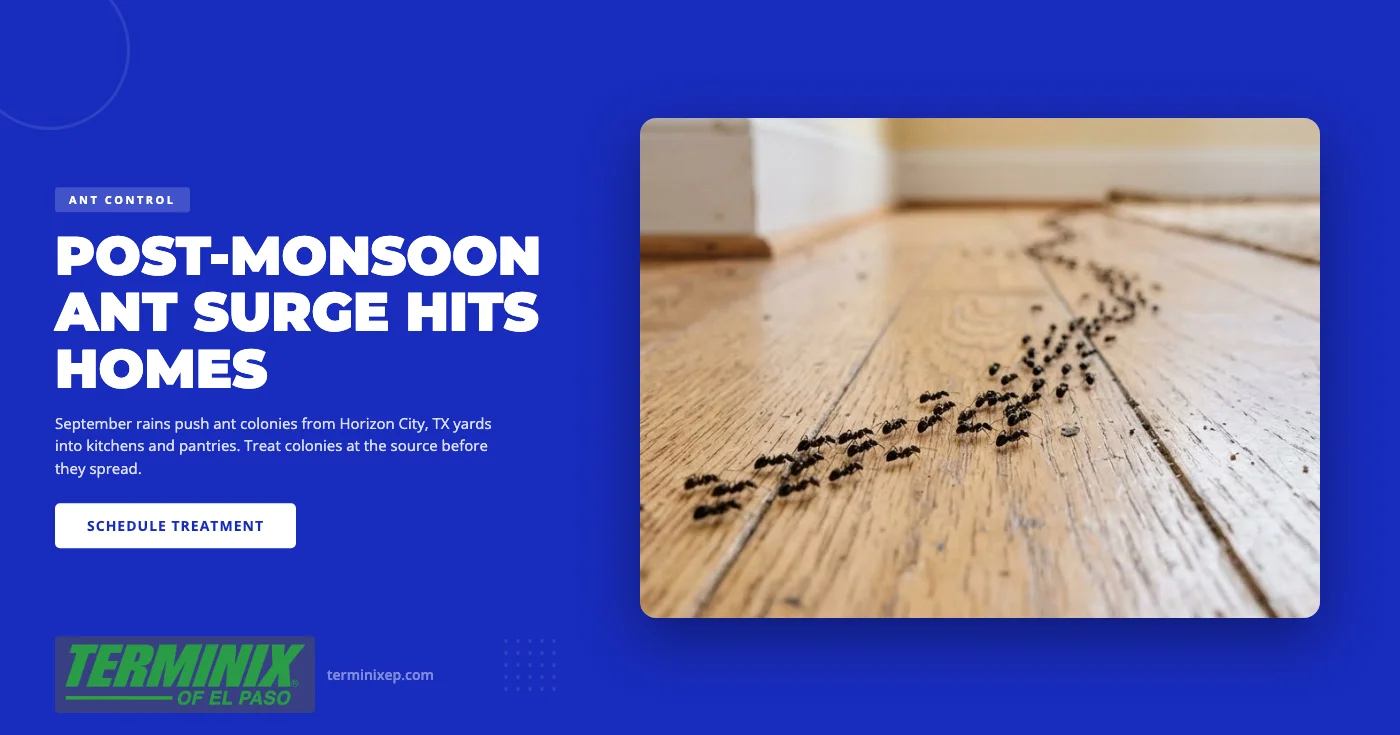
- Trails along baseboards, countertop edges, and window sills. A steady line of workers moving in the same direction is a foraging column that has already located food or water inside the home.
- Sawdust-like frass near window frames or porch posts. Carpenter ant activity leaves small piles of clean, coarse wood shavings — the excavated material from their galleries.
- Winged ants inside the home. Winged reproductives inside a house in September usually mean a mature colony is nesting in or against the structure.
- Kitchen and pantry contamination. Ants in sugar, honey, opened cereal, or pet food. Odorous house ants and pavement ants are particularly persistent once they have located a sugar source and will recruit within an hour.
- A distinctive licorice or rotten-coconut smell when crushing an ant. Diagnostic for odorous house ants and useful for confirming which treatment plan a technician should run.
The Texas A&M AgriLife household ant identification guide emphasizes that most homeowner treatments fail because the species was misidentified, not because the product was ineffective. Confirming the species is the first job before any spray, bait, or drench decision.
Effective Ant Prevention Strategies for El Paso Desert Homeowners
The last three weeks of September and the first two of October are the right window to close entry points and correct the outdoor conditions that create ant pressure. The steps that move the needle in Horizon City conditions:
- Seal cracks in exterior walls, expansion joints, and weep holes. Ants pass through gaps under 1/16 of an inch. Weep holes in stucco can be screened with stainless mesh; slab expansion joints benefit from a fresh backer rod and sealant every few years.
- Audit and adjust irrigation. Drip emitters should sit at least a foot away from the foundation, and broadcast sprinklers should not spray directly against the slab. A single adjusted zone can drop foundation-edge moisture by half within a week.
- Pull mulch and rock landscaping back from the slab. A clean, dry, six-inch soil margin is the single most effective landscape change you can make.
- Repair leaks and eliminate standing water. Slow drips under sinks, leaky evaporative cooler pans, and standing water in outdoor pet bowls all sustain colonies through the dry season.
- Store food and pet food in sealed containers. Cardboard boxes and paper bags are recruitment triggers. Metal or heavy plastic with tight lids removes the food source almost completely.
- Rake and remove yard debris and firewood. Piled leaves, unused planter pots, and firewood stacked against the house all provide harborage. Move firewood well away from the exterior wall.
None of these steps ends an active colony on their own. What they do is reduce pressure enough that whatever treatment you or a professional applies actually holds through the fall.
How Terminix of El Paso Eliminates Ant Infestations in Horizon City
Our ant exterminator Horizon City Texas work follows a four-step protocol adapted to the species mix, construction style, and outdoor habitat pressure specific to the borderland. The regulated toolkit — broadcast granular baits for fire ant management, non-repellent perimeter residuals, and species-specific gel baits for indoor colonies — reflects the practices detailed in the Texas Imported Fire Ant Research and Management Project guidance.
- Full inspection and species identification. Our technician walks the exterior perimeter first — mounds along property lines, cracks in the driveway, water meter boxes, slab expansion joints, downspout discharges, and weep holes — then works the interior. We confirm the species before quoting a treatment, because the plan for fire ants is very different from the plan for carpenter ants or odorous house ants.
- Targeted, species-appropriate products. For fire ant management we apply an EPA-registered granular bait broadcast across the yard, then follow with individual-mound treatment on any active mound at the property line. For carpenter ants we locate the parent nest and treat directly. For odorous house ants and pavement ants we place non-repellent gel baits along interior trails and apply a non-repellent residual to the exterior perimeter — no aerosols that scatter foraging columns.
- Habitat and moisture corrections. Irrigation adjustments, mulch pullback, downspout extensions, exterior light repositioning, and structural gap sealing. Without these, even a well-executed product application is fighting the same conditions that produced the infestation.
- Follow-up and ongoing monitoring. Fire ant broadcast baits work slowly — the goal is queen elimination, not fast knockdown, and a follow-up visit at three to four weeks confirms mound reduction. Every treated home goes onto a monitoring cycle with re-treatment included if activity returns within the warranty term.
Modern non-repellent residuals and enclosed granular bait stations are designed with families in mind — applications go into cracks, crevices, mound perimeters, and exterior harborage where household traffic does not reach, and every technician walks the homeowner through what was applied and any re-entry window before leaving. Peace of mind that the treatment will hold is exactly what our four-step protocol is built around.
Frequently Asked Questions About Post-Monsoon Ant Control in Horizon City, TX
Which ant species is most common in Horizon City TX homes in September?
The mix shifts by yard type, but red imported fire ants dominate open turf and pavement ant activity is heaviest along driveways and slab edges. Indoors, odorous house ants are the most common kitchen trail once outside conditions dry down after the monsoon.
Are ant treatments gentle around pets and children?
The non-repellent residuals, granular baits, and enclosed gel bait stations we use in Horizon City homes are designed with families in mind. Interior applications go into cracks and crevices where pets and children do not reach, and exterior work is applied to foundations, landscape edges, and turf harborage rather than open play areas. Our technician walks every homeowner through what was applied and any re-entry window before leaving the property.
How long does an ant treatment last in Horizon City conditions?
Exterior perimeter treatments in Horizon City's September conditions typically hold 60 to 90 days before re-treatment is warranted, shorter during a late-monsoon storm burst and longer once the desert dries down through October and November. Fire ant broadcast baits take three to four weeks to reduce mound counts, and a follow-up visit confirms the queen was eliminated before the program moves to monitoring.
Can I treat fire ants myself with retail products in Horizon City?
Retail contact sprays and mound drenches kill visible workers but rarely reach the queen. If the queen survives, the mound relocates a few feet away and rebuilds within days. Broadcast granular baits work, but require careful timing on temperature, humidity, and forager activity to be effective. If mounds are numerous, if fire ants are close to a play area, or if anyone in the home has a bee or wasp sting allergy, a professional inspection is worth the call.
If September's post-monsoon dry-down has pushed ants into your Horizon City home, or you want a baseline yard inspection before the fall foraging window closes, reach out. We will give you a written diagnosis and treatment plan whether or not a full program is the right next step. Schedule an ant inspection with Terminix El Paso.


 Mon – Fri: 8:00 am – 5:00 pm


