

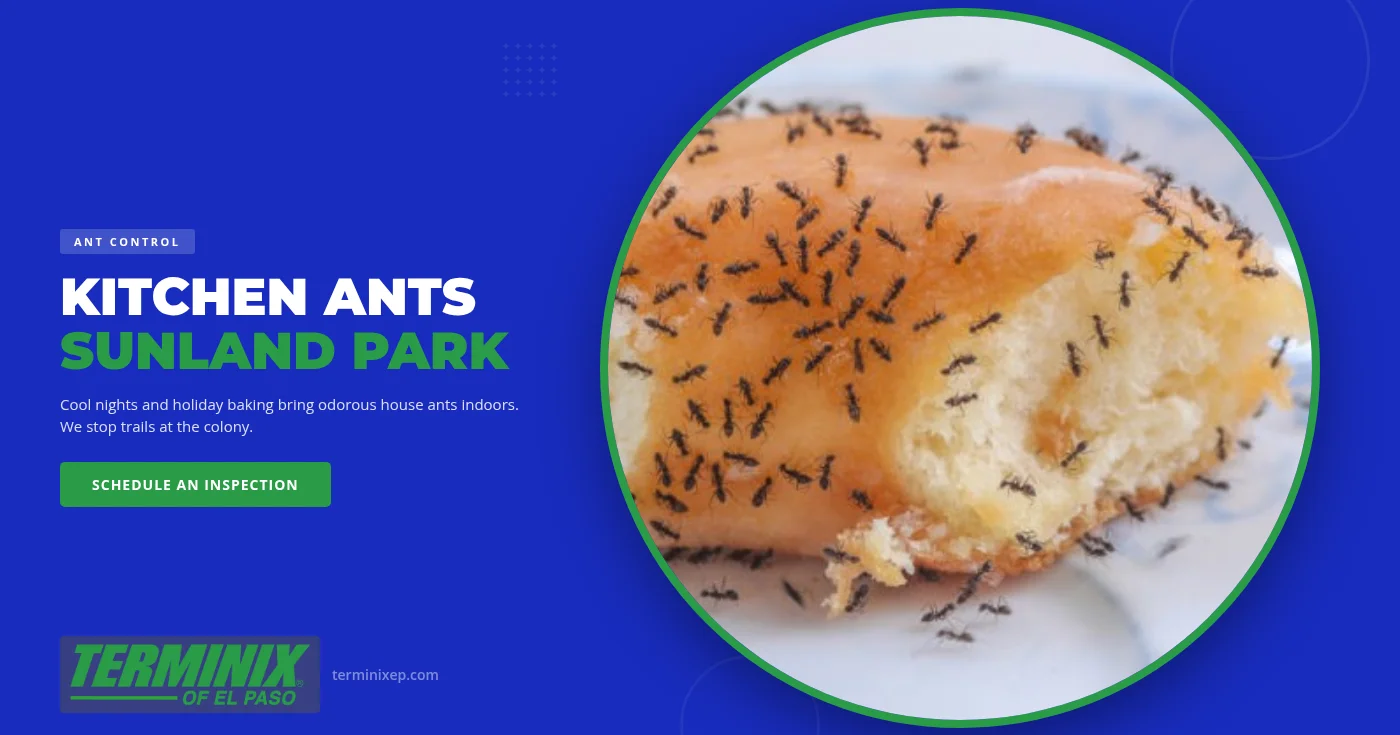
The first crisp mornings of November bring a familiar sight to a lot of kitchens: a thin, wandering line of tiny dark ants marching across the counter toward the sugar canister, the fruit bowl or the dog’s dish. It’s one of the most common calls our ant control team gets this time of year. If you’ve been typing “ant control Sunland Park NM” into a search bar after spotting a trail by the sink, you’re in good company.
The culprit is usually the odorous house ant, a tiny, stubborn species that takes full advantage of the season. As nights cool across Sunland Park and holiday baking kicks into gear, colonies that spent the summer outdoors start looking for steady food, moisture and warmth. Our kitchens and pantries offer all three.
Here at Terminix, we want you to understand what you’re dealing with before you reach for a spray can. In this post, we’ll cover why ants move indoors in fall, how to identify odorous house ants, what draws them inside, where colonies hide, why store-bought fixes often backfire and how professional treatment stops a fall ant infestation at the source. We’ll finish with answers to the questions we hear most.
Our corner of southern New Mexico sits in the Chihuahuan Desert, where November days can still feel pleasant while nights turn noticeably cold, and late-month freezes are possible in some years. For ants, that daily swing matters. Odorous house ants build shallow nests in soil, and according to the Washington State University Extension fact sheet on odorous house ants, those colonies are temporary because the ants move often. When the ground near the surface cools at night, a nest a few inches deep doesn’t offer much protection, so foraging workers start exploring the warmer, steadier spaces inside our homes.
Moisture plays a role too. The summer monsoon is long gone by November and the desert air turns dry. A slow drip under the sink, condensation around a water heater or damp soil beside a leaky hose bib can become a magnet for a colony trying to hold on through winter. Shifts in temperature and weather are widely reported to push these ants indoors, though exact behavior can vary from one home to the next.
It usually starts with a few scouts. WSU notes that scouting workers search anywhere food might be found. Once a scout finds something worth carrying home, it leaves a scent trail, and within hours you may see dozens or even hundreds of workers following the same path along a baseboard, up a cabinet edge and across the counter. That’s why a handful of ants on Monday can become a full parade by Wednesday.
Many people call any small kitchen ant a “sugar ant,” but several species fit that description. If you’re seeing sugar ants in the kitchen this fall, look for these telltale traits of odorous house ants:
These ants don’t typically sting, and they aren’t known for damaging wood the way carpenter ants or termites can. The real problem is contamination and sheer numbers. They crawl over food, dishes and countertops, and a single steady trail can point to a large, well-established colony nearby.
If the ants you see are reddish, sting, or come from mounds in the yard, you may be dealing with a different species, such as fire ants or harvester ants, which call for a different approach. If you’re unsure, snap a close-up photo and save a few specimens in a sealed bag. Our technicians can confirm the species during an inspection, and that identification shapes the right treatment plan.
WSU’s fact sheet notes that indoors, odorous house ants go for dairy products, fruit juices and pastry. Read that list again with November in mind. Between Thanksgiving pies, pan dulce, biscochitos and the tamale-making that ramps up in December, kitchens across the borderland see more flour, sugar, butter and sweet residue than at any other time of year.
A few habits make a real difference. Store baking staples in airtight containers with tight lids. Wipe counters after every baking session, not just at the end of the day. Rinse sticky containers before putting them back. For pets, pick up bowls between meals when you can, or set the bowl inside a shallow dish of soapy water, which can help create a moat ants struggle to cross.
WSU also recommends wiping up ants and their trails with soapy water, which removes the scent trail other workers follow. That’s a smart first step, but it doesn’t touch the colony itself, so trails often return within a day or two.
A trail is only the visible part of the problem. The colony is usually tucked somewhere protected, and odorous house ants aren’t picky. Common hiding spots indoors include:
Outdoors, they nest under landscape rock, pavers, mulch, potted plants and debris piled against the foundation. Shrubs or tree branches touching the house act as bridges, which is why WSU advises trimming vegetation so it doesn’t contact the building.
WSU suggests following the trail with a flashlight to locate the nest. It’s worth a try: watch where workers carrying food disappear. Often they slip into a gap behind an outlet cover, a crack in the grout or the seam where a baseboard meets the slab. If the trail vanishes into a wall, you’ve likely found a wall void colony, one of the hardest places to reach with off-the-shelf products. WSU also cautions that sealing entry points “can be extremely difficult since the ants are small,” so caulking helps, but it rarely solves the problem alone.
When a trail appears, the instinct is to grab a can of spray. It kills the ants you can see, which feels like progress. Unfortunately, the workers on the counter are a small fraction of the colony, and the queens stay hidden.
Odorous house ant colonies are widely reported to contain multiple queens, and entomologists describe a process called budding, where workers and one or more queens break off to start a new nest nearby. Repellent sprays are often cited as a trigger: a disturbed colony may scatter and set up in several new spots instead of one. The result can be more trails in more rooms a week or two later. It’s no surprise WSU calls odorous house ants “perhaps the most difficult ants in our area to discourage.”
Baits are a better idea than sprays in principle, because slow-acting sugar baits are designed to be carried back and shared with the queens. In practice, several things can go wrong:
If you do use store-bought products, always read and follow the label directions, and keep baits out of reach of children and pets.
Here at Terminix, we treat a fall ant infestation as a colony problem, not a countertop problem. Our approach typically includes:
Every home is different, so timelines vary. Many households notice trail activity drop within days, while a deeply established colony can take longer. We’ll walk you through what to expect.
Ants rarely travel alone in the cooler months. The same warm, damp spots that attract odorous house ants also appeal to other pests, so if you’re seeing more than ants, our cockroach control and silverfish control services can be folded into the same visit.
Cooler nights make shallow outdoor nests less comfortable, and dry fall weather sends colonies looking for moisture. Add the extra sugar and crumbs from holiday baking, and your kitchen becomes the most attractive spot on the block.
They don’t typically sting and aren’t known to damage your home’s structure. The concern is contamination, since they walk across food, dishes and prep surfaces, plus the frustration of trails that keep coming back.
Sprays only kill the workers you can see. The queens remain hidden, and disturbing the colony may cause it to split into several smaller nests, which can mean more trails later.
We choose targeted products and placements with families and pets in mind, and we explain any simple precautions, such as keeping pets away from treated areas until they dry. If you have specific concerns, just let us know during your inspection.
Odorous house ants are small, but a fall ant infestation can turn holiday baking into a daily cleanup battle. Wiping trails, sealing food and trimming plants all help, yet lasting results usually come from finding and treating the colony itself.
Here at Terminix, we proudly provide pest control in El Paso and nearby areas, and we know how borderland homes change with the seasons. If you’re searching for ant control Sunland Park NM homeowners can lean on, contact us today to schedule an inspection and get your kitchen back before the holiday guests arrive.
When ant trails keep showing up no matter how often you wipe the counters, it’s time to go after the colony instead of the workers. That’s exactly what we do. Here at Terminix, we focus on finding where ants are nesting and treating them at the source, so your kitchen and pantry stay clear through the holiday season.
Our ant control service includes:
We know odorous house ants can be stubborn, and we know how frustrating it is to find them in the sugar or the pet food bowl right when you’re getting ready for family gatherings. We choose products and placements with kids and pets in mind, and we’ll explain every step so you have peace of mind from the first visit.
We also handle the other pests that like to move indoors when the weather cools, from cockroaches to silverfish, so one visit can cover more than one concern.
Ready to stop the trail? Reach out to our team to schedule your inspection, and let us help you enjoy an ant-free kitchen this season.
 Mon – Fri: 8:00 am – 5:00 pm


