

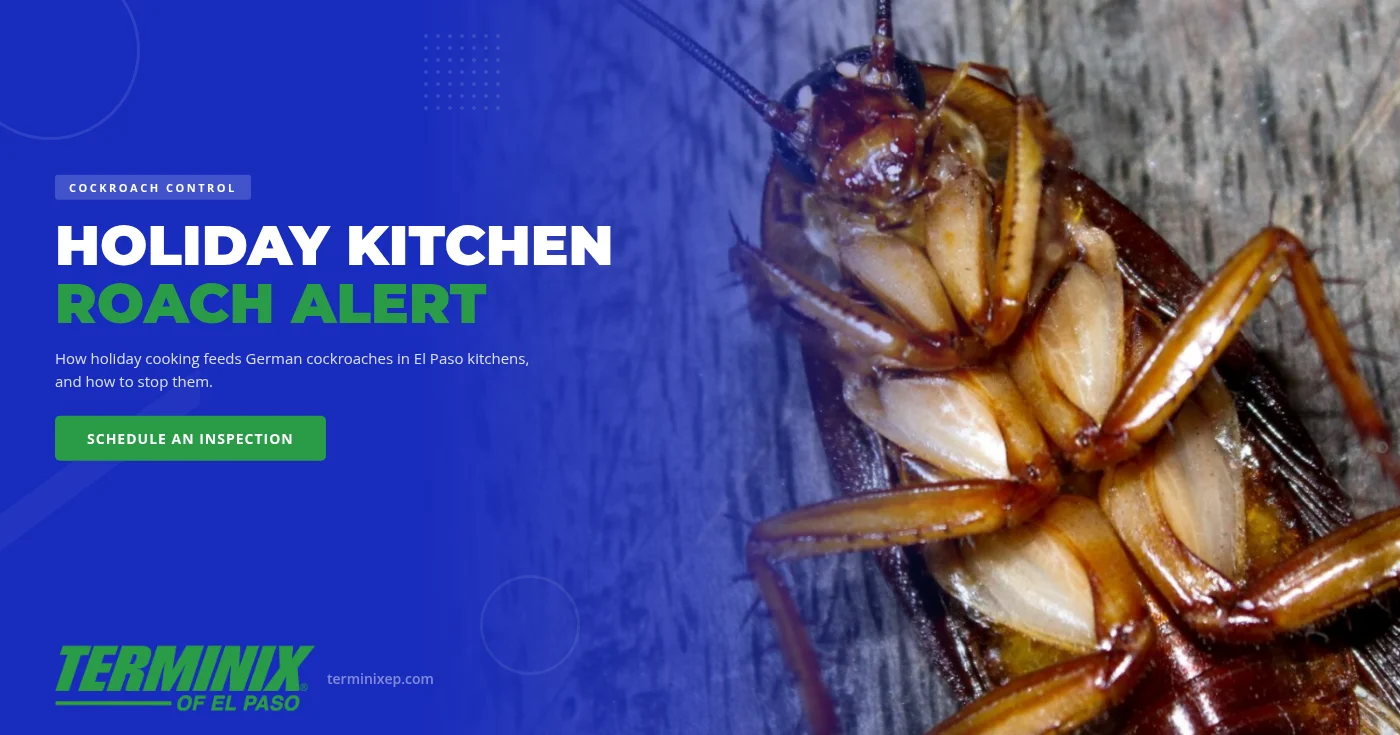
The oven runs for hours, the pantry is stacked with flour, masa harina and canned goods, and the trash fills faster than anyone can carry it out. November is the busiest month in many kitchens across El Paso, and German cockroaches notice.
If you’ve spotted a small tan roach darting under the stove, you’re not alone. This is the time of year when we hear the most questions about cockroach control El Paso homeowners can rely on, because holiday habits hand these pests exactly what they want: warmth, crumbs, grease and water.
Here at Terminix, we want your kitchen ready for guests, not roaches. Below, we cover why November draws cockroaches in, how to tell German cockroaches from outdoor roaches, the habits and appliances that feed them, warning signs to look for, a room-by-room checklist, and what professional treatment looks like when store-bought baits aren’t enough.
German cockroaches live indoors year-round, so they don’t “move in” for winter the way some pests do. What changes in November is the environment we create for them. Nights in our area often dip into the high 30s or low 40s, and the first freeze tends to arrive sometime in mid-to-late November. Heaters switch on, windows stay shut, and the kitchen becomes the warmest, busiest room in the house.
Cooking ramps up at the same time. Thanksgiving baking, tamale season, potlucks and family dinners mean more grease on the stovetop, more crumbs under the toaster and more dishes waiting in the sink overnight. Each of those is a meal for a roach.
Our desert climate adds a twist. Because the air here is so dry, water, not food, is often what limits a roach population. The German cockroaches El Paso families find usually cluster wherever moisture lingers: under the sink, around dishwasher seals, near refrigerator drip pans and beside pet water bowls. Holiday kitchens tend to have more of all of these, and they stay wet longer.
Finally, the season brings a flood of cardboard. Grocery bags, warehouse-store boxes, shipping deliveries and visitors’ luggage can all carry hitchhiking roaches or egg cases straight into your pantry.
Not every roach is the same, and the type you’re seeing tells us a lot about the problem.
Adults are small, roughly ½ to ⅝ inch long, light brown to tan, with two dark parallel stripes on the shield behind the head. They have wings but rarely fly. Resources from Texas A&M AgriLife Extension’s urban entomology program describe them as a true indoor pest that depends on human living spaces for warmth, food and moisture.
They reproduce quickly. A female carries an egg case holding roughly 30 to 48 eggs until it’s nearly ready to hatch, and nymphs can reach adulthood in about six to twelve weeks at room temperature. One female can produce several egg cases in her lifetime, which is how a handful of roaches can become hundreds, or even thousands, within a few months.
Larger roaches, like the reddish-brown American cockroach many people call a “water bug,” usually live outdoors, in drains or in sewers and wander inside now and then. Seeing one is unpleasant, but it doesn’t always mean there’s a colony inside your walls.
A German cockroach sighting is different. Because they hide during the day and stay tucked into tight cracks, spotting even one usually means more are nearby.
German cockroaches aren’t picky eaters. They’ll feed on nearly anything we leave behind, and the holidays leave behind a lot.
None of this means your kitchen is dirty. Even tidy homes see more crumbs and moisture this time of year. The goal is simply to shrink the buffet so roaches have fewer reasons to stay. These same steps also discourage sugar-loving ants, so if you’re seeing trails along the counter, our ant control service can help with that too.
German cockroaches prefer tight, warm, humid spaces close to food and water. Appliances check every box, which is why roaches in kitchen appliances are one of the most common things we find during inspections.
The motor housing at the back stays warm, and the drip pan underneath collects water. Roaches living behind the refrigerator are a classic sign of an established infestation.
Gaps between the stove and the cabinets collect spills and crumbs, and the warm space around the oven provides shelter. Heavy holiday use only adds heat and food.
Door seals, the kick plate and the area under the unit stay damp, and food residue in the filter adds to the appeal.
Small appliances offer warm motors, crumbs and, in a coffee maker’s case, water. Roaches can hide inside the housing, which is why some people see them crawl out of a device they just switched on.
Before the holidays, pull larger appliances out once, vacuum behind and beneath them, and wipe away grease. If you find droppings or egg cases back there, the population may be bigger than it looks.
Roaches are nocturnal, so an infestation can grow for weeks before anyone sees a live insect. A quick flashlight check a week or two before your gathering can tell you a lot. Look for:
Focus on the cabinet under the sink, the cabinet above the refrigerator, cabinet door hinges and the edges of the dishwasher. If you find more than one of these signs, it’s worth acting now rather than waiting until the house is full of family. A kitchen cockroach infestation rarely shrinks on its own, and the holiday rush usually makes it worse.
Good holiday pest prevention doesn’t require a deep clean every day. A few focused habits make a real difference.
Sealing gaps and clearing clutter also makes your home less inviting to mice looking for warmth this season. If you hear scratching in the walls, our rodent control team can take a look.
Store-bought products can knock down a few roaches, but German cockroaches are notoriously hard to eliminate on your own.
Foggers, or “bug bombs,” don’t reach the cracks and voids where roaches hide, and repellent sprays can push roaches deeper into walls. Spraying near bait can also keep roaches from eating it. On top of that, university research, including a 2019 Purdue University study, suggests German cockroach populations can develop resistance to several insecticides quickly, so relying on one product may stop working.
Professional treatment follows integrated pest management (IPM), the approach university extension programs recommend:
Here at Terminix, we tailor each plan to your kitchen, and we’re glad to explain which products we use and where we place them, so you have peace of mind around kids, pets and food-prep areas.
German cockroaches can hitchhike in on groceries, boxes or used appliances, and they can travel between units through shared walls. A clean kitchen helps, but a few crumbs and a damp sink are enough to keep a small population going.
Not German cockroaches. They live indoors year-round, and heated homes with busy holiday kitchens give them ideal conditions. Outdoor species may slow down in cold weather, but indoor roaches keep breeding.
They can be. The U.S. Environmental Protection Agency lists cockroach allergens among common indoor asthma triggers, and roaches may carry bacteria on their bodies. If anyone in your home has asthma, reducing roach activity is worth talking over with your doctor as part of a broader plan.
As soon as you notice signs, and ideally a few weeks before guests arrive. That gives baits and growth regulators time to work and leaves room for a follow-up visit before the big meal.
Holiday cooking doesn’t have to mean holiday roaches. With a few changes to how you store food, handle moisture and check your appliances, you can make your kitchen far less inviting. When signs point to an established population, professional cockroach control El Paso homeowners can count on is the fastest way back to a kitchen you’re proud to share.
As a local team based right here, Terminix knows how our dry desert climate and busy holiday season shape roach problems. Contact us today to schedule your inspection and enjoy the season with peace of mind.
We can. Our team handles cockroach control for homes and businesses throughout El Paso, and November is when we see German cockroaches settle into busy holiday kitchens. As a local cockroach exterminator El Paso TX families call when store-bought baits stop working, we focus on finding where roaches hide, not just the ones you see.
Here’s what you can expect when you call us:
We’re happy to explain the products we use and where we apply them, so you have peace of mind around children, pets and food-prep areas. We also help with ants, rodents, scorpions and many other pests common in our desert climate.
Don’t let roaches be the uninvited guests at your table this year. Reach out to schedule your inspection, and let us help you get your kitchen ready for the season.
 Mon – Fri: 8:00 am – 5:00 pm


