

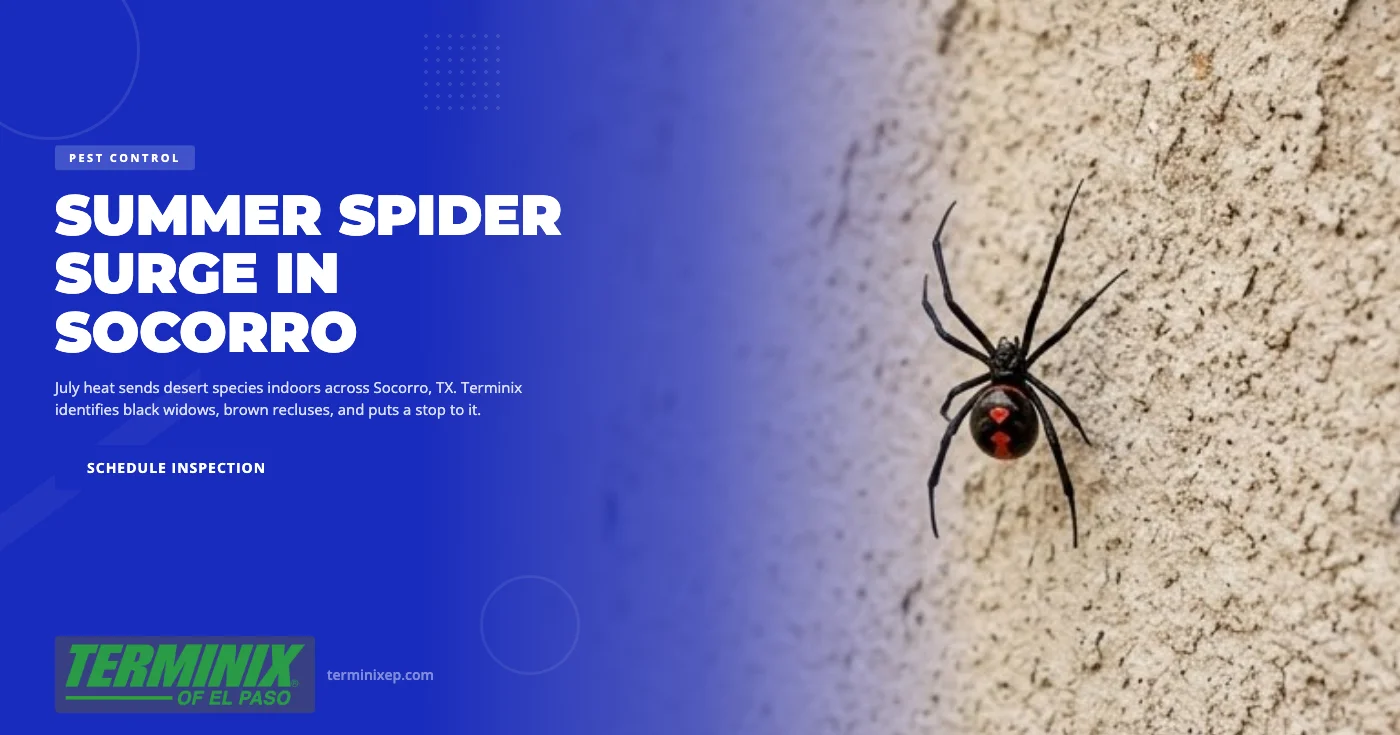
If mid-July has your Socorro home turning up more spiders on ceilings, in garage corners, and inside stored boxes, you're seeing the same annual surge we field calls about across El Paso County. The drivers — desert heat, incoming monsoon moisture, and the prey insects those two conditions unleash — have almost nothing to do with your housekeeping and everything to do with the Chihuahuan Desert calendar.
At Terminix of El Paso, we handle the spider control Socorro TX homeowners rely on to interrupt this pattern before a few sightings become a full harborage problem. Below we'll unpack why July heat drives the surge, which species deserve real caution, where they hide, how the monsoon amplifies the cycle, and what our treatment plan does to keep activity down through the rest of summer.
El Paso County sits in the northern Chihuahuan Desert, and our July weather pattern is fairly consistent from year to year — daytime highs in the mid-90s to low 100s, overnight lows in the upper 60s to upper 70s, and building humidity as monsoon moisture pushes north. According to the National Weather Service El Paso, the North American Monsoon typically begins in late June or early July, shifting the region from bone-dry to storm-prone in a matter of weeks.
Spiders are cold-blooded predators — they don't chase heat directly, they chase prey. Nothing kicks off a desert prey boom like this combination of extreme afternoon temperatures, warm nights, and rising humidity. Crickets, moths, gnats, and beetles multiply fast, and the black widows, brown recluses, wolf spiders, and orb weavers around your foundation suddenly have more to eat than they've had all year.
Then the migration begins. Air-conditioned interiors hold a steady 72 to 78°F while exterior surfaces bake at 105 to 130°F. To a spider hunting along the foundation, an open garage gap or torn door sweep leads directly to stable temperatures and plenty of prey drawn to indoor lights at night. By mid-July, we see a sharp jump in spider control Socorro TX calls across the eastern El Paso corridor.
Most spiders we encounter in the Socorro area are harmless — wolf spiders on floors, jumping spiders on windowsills, orb weavers on porch corners. But two species deserve real caution, and both are well-established across the El Paso region.
The two we take seriously both favor low-traffic storage zones that exist in nearly every Socorro-area home — which is why our inspections start there rather than the living rooms where the harmless species show up.
The spiders on ceilings and baseboards are usually a small fraction of the total population on your property. The larger group hides in the same handful of zones we check first on every inspection:
Once we map these zones, the treatment plan matches the actual harborage patterns on your property — not a generic perimeter spray that misses the population.
The July spider surge isn't a single trigger — it's a chain reaction with monsoon moisture as the accelerant. The National Weather Service tracks the North American Monsoon as it shifts the region into a moisture-rich pattern each July, delivering 40 to 60% of the wider region's annual precipitation.
Here's how that plays out for spider activity on your property:
By late July and early August, this chain reaction produces the highest spider densities of the year across the Socorro corridor — and waiting to act usually means the population has already established indoor harborage.
Most spider bites in our area are minor. The two species we've flagged — black widow and brown recluse — are the exceptions, and both merit medical attention.
Black widow bites can produce abdominal cramping intense enough to be mistaken for appendicitis, muscle rigidity, profuse sweating, headache, elevated blood pressure, and nausea. According to Texas Department of State Health Services, children, older adults, and people with existing cardiovascular conditions face the most severe reactions. Symptoms typically appear within an hour and can persist for one to three days.
Brown recluse bites often start as little more than a pinprick and become visible over 24 to 72 hours as a red, white, and blue lesion — pale center, red inflammation, dark ring — that can develop into a slow-healing ulcer. Fever, chills, nausea, and joint pain sometimes accompany the local reaction. Necrotic ulcers are uncommon overall, but when they occur they take weeks to heal.
Any bite from a suspected widow or recluse warrants a call to the Texas Poison Center Network and follow-up with your primary-care provider. If a child is bitten, if breathing becomes difficult, or if the bite site develops rapidly spreading redness, seek emergency care immediately. Bring the spider in a sealed container when possible so the species can be confirmed.
Effective spider control Socorro TX households can count on isn't a single perimeter spray. It's a layered approach that targets active spiders, removes the harborage drawing them in, and stays on a schedule that interrupts the breeding cycle.
Our process starts with a detailed inspection — exterior walls, garage interiors, attic access points, storage zones, and the landscape perimeter. We document every active web, egg sac, harborage area, and entry point, then build a treatment plan around what's actually happening on your property. From there, we apply professional residual products to the foundation perimeter, eaves, weep holes, and known harborage zones; hand-remove visible webs and egg sacs; and treat interior crack-and-crevice zones in garages, attics, and closets where medically significant species hide.
Recurring service every two to three months keeps the residual barrier intact through monsoon season and into fall. The same visit covers the other desert pests traveling the same routes — scorpion control, cricket control, and the general pest pressure that drives spiders indoors.
If webs keep rebuilding within days of clearing, if you're finding multiple spiders in the same room over a week, or if a black widow or brown recluse shows up anywhere on the property, this is the point to bring in professional help. Households with kids, pets, or family members with known venom sensitivity have extra reason to act early.
With a 4.9-star rating across more than 240 reviews, our team serves Socorro alongside El Paso, Horizon City, Canutillo, Fort Bliss, and Sunland Park. Visit us online or contact us today to schedule your spider inspection — July activity ramps quickly across El Paso County, and the gap between a few sightings and a full-scale problem is usually a matter of weeks.
July combines three triggers — peak daytime heat pushing spiders toward stable indoor microclimates, incoming monsoon moisture that ignites prey insect populations, and the tail end of brown recluse mating season leaving fresh egg sacs in garages and attics. Most of the spiders showing up inside were already near your foundation and just became more visible.
Start outside: move stored items off exterior walls, clear webs from block-wall caps and irrigation valve boxes weekly, and replace worn garage door bottom seals. Inside, shift storage from cardboard to sealed plastic totes and shake out shoes and gloves before use. For established widow activity, a professional treatment reaches crack-and-crevice zones DIY sprays miss and lays a residual barrier that holds up in desert heat.
Two — the Western black widow and the brown recluse. Widows are glossy black with a red hourglass on the underside; recluses are tan-brown with a darker violin-shaped mark on the head region. If you're not certain what you've found, photograph it from a few feet away and let our technicians confirm the species during an inspection.
The products we use are EPA-registered and applied by licensed technicians at label rates designed with families in mind. We ask homeowners to keep pets and children indoors during application and until products dry — typically 30 minutes to an hour. After that, the home and yard return to normal use.
Yes — Socorro is part of our regular service area, alongside El Paso, Horizon City, Canutillo, Fort Bliss, and Sunland Park. Contact us to schedule your spider inspection and get ahead of the July surge.


