

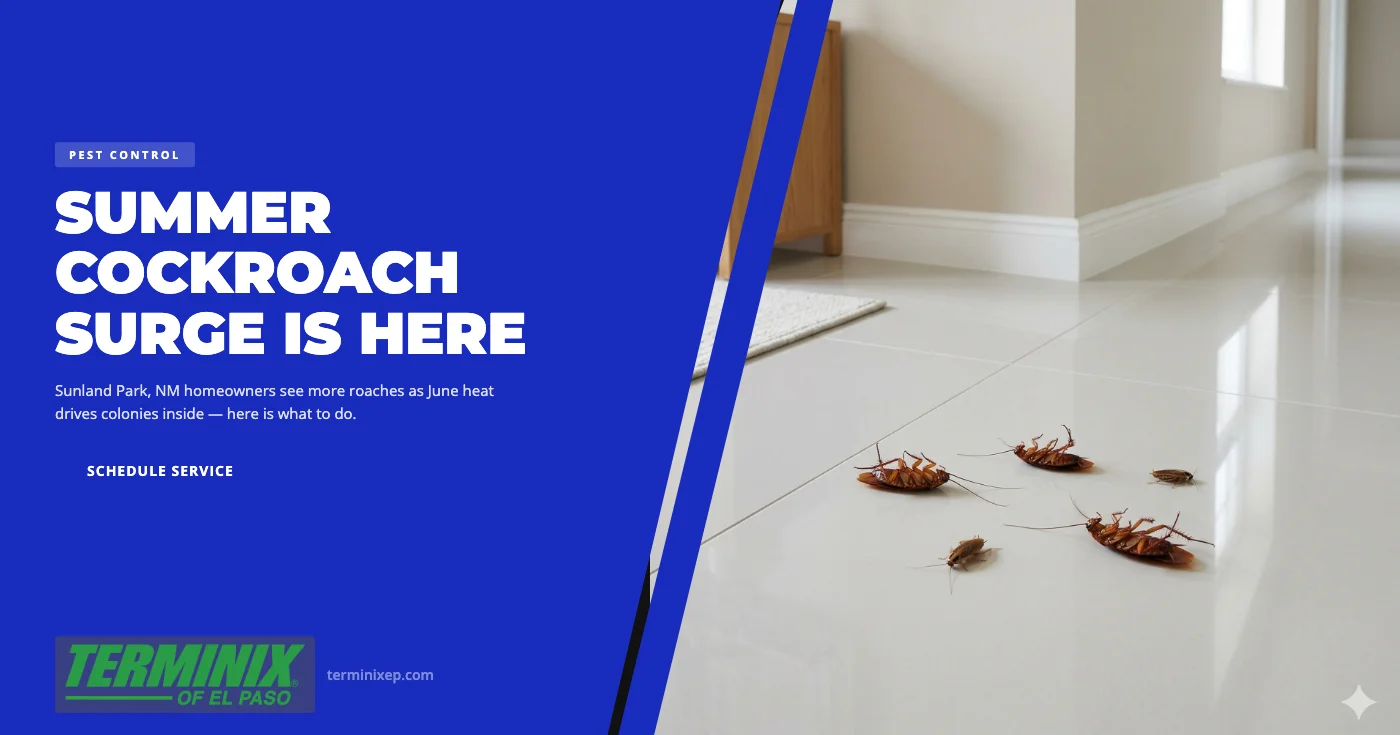
If you live in Sunland Park, NM, you already know what June feels like — triple-digit afternoons, bone-dry air, and a sun that refuses to quit. What most homeowners don't expect is that the same heat punishing the patio is also pushing cockroaches straight into the kitchen. Every summer we see the same pattern across our service area: as soon as outdoor temperatures hit the mid-90s and overnight lows climb above 70°F, roach sightings indoors spike. The desert is not killing these insects — it is driving them toward the only reliable water and shelter for miles, which happens to be your home.
In this guide, we walk through why the surge happens, which species we actually find in Sunland Park homes, the health risks behind a roach problem, and how we approach cockroach control in Sunland Park, NM when prevention has already failed.
Sunland Park sits in a mid-latitude desert climate that the Köppen system classifies as BWk — hot, dry, and stingy with rainfall. June is the hinge month. Average highs climb to roughly 94.6°F, and relative humidity often hovers around 23%. For a cockroach, that combination is a survival emergency. Roaches lose moisture quickly through their exoskeleton, and once outdoor humidity drops below about 30%, they cannot stay hydrated long enough to forage, breed, or even survive a single day in open ground.
That is why our technicians watch the forecast as closely as our customers do. When daytime temperatures jump and monsoon moisture has not yet arrived, every adult roach within a few hundred feet of your foundation begins hunting for shaded soil, irrigated landscaping, or — most often — the cool, humid microclimate behind your appliances. By the time most homeowners notice the first one skittering across the tile, dozens more are already nesting in wall voids, under the dishwasher, and inside the slab cracks that almost every Sunland Park house has by year ten.
Not every roach is the German cockroach you might remember from a college apartment. Border-region homes deal with a specific mix of species, and the treatment for each one is different. These are the four we see most often in Sunland Park:
Knowing which species we are dealing with matters because it changes everything downstream — bait choice, treatment depth, and how aggressively we have to address the yard versus the interior.
Cockroaches do not break in — they walk in through openings that have been waiting for them all year. In Sunland Park, the most common summer entry points we identify on inspections are:
The pattern is almost always the same: outdoor populations build up in landscaping during spring, the June heat snaps the humidity out of the soil, and the colony advances toward the nearest steady water source. In a typical Sunland Park home, that source is the slab plumbing under the kitchen sink — which is why the first roach a family spots is so often near the trash can or behind the dishwasher.
A cockroach problem is not just unsettling — it is a documented health hazard, especially for kids. The EPA, CDC, and National Institutes of Health all identify cockroach allergens as a leading environmental trigger for childhood asthma. In urban and suburban homes, 40–60% of asthma patients carry IgE antibodies to cockroach allergens, and exposure has been directly linked to higher hospitalization rates, more missed school days, and worse nighttime symptoms in sensitized children.
The allergens come from roach feces, shed exoskeletons, saliva, and decomposing body parts. As a colony grows inside a wall void or under an appliance, those particles work their way into household dust and become airborne. Peer-reviewed research published by the National Institutes of Health shows the link is strong enough that allergists routinely test for cockroach sensitivity in kids with persistent asthma.
On top of allergens, cockroaches mechanically transfer bacteria from sewer lines and trash onto food prep surfaces. We have pulled adult roaches out of dishwasher motor housings, sink overflow chambers, and the underside of toaster ovens — none of which get cleaned during a normal wipe-down. Treating the colony quickly is the only reliable way to bring the allergen load down to a tolerable level.
You can meaningfully reduce roach pressure on your home before it becomes an infestation. These are the five steps we recommend to every Sunland Park homeowner during a summer inspection:
None of these steps eliminate an existing colony, but together they remove the conditions that make a colony possible in the first place.
We see a familiar cycle every summer. A homeowner buys a hardware-store spray, douses the baseboards, watches the visible roaches die within a day or two, and assumes the problem is solved. Three weeks later, the population is back — usually worse.
There are three reasons over-the-counter products struggle here. First, the active ingredients in consumer sprays are mostly contact-kill — they handle the adults you can see but do nothing to the nymphs hidden in wall voids or the egg cases tucked behind appliances. Second, our outdoor roach pressure is so high that any reduction inside is quickly replaced from the yard, especially with Turkestan populations breeding aggressively all summer. Third, the foggers and broadcast sprays sold for general use can actually scatter a German cockroach colony — pushing them deeper into walls and across to neighboring rooms instead of consolidating them on a bait.
Professional treatment uses targeted gel baits, insect growth regulators, and exterior perimeter applications calibrated to local species behavior. The goal is not just to kill visible adults — it is to break the reproduction cycle so the colony cannot rebuild.
When we are called to a Sunland Park home with a roach problem, we start with a full inspection — interior and exterior, slab to attic. We identify the species, map the harborage points, and look at the conditions that pulled the colony inside in the first place. That diagnosis drives the treatment plan, not a one-size-fits-all spray schedule.
For German cockroach problems, we work in tight kitchens and bathrooms with targeted bait placements, growth regulators, and follow-up visits to confirm the colony has collapsed. For the outdoor species — American and Turkestan especially — we treat the perimeter, address irrigation and harborage conditions, and set up a recurring barrier so the next wave does not come right back through the slab.
Every plan is built around your home, your family, and the species we actually find on site. If you are seeing roaches inside this summer, the colony is already established and time matters. We can walk through your home, identify the entry points, and put a real plan in place. Learn more about our cockroach control services for Sunland Park and the surrounding area.
Sunland Park summers push outdoor humidity below the level cockroaches can survive in. They follow plumbing chases, slab cracks, and door gaps toward the cool, humid microclimate inside your home — typically the kitchen and bathrooms. The hotter and drier it gets outside, the more pressure your foundation is under.
Start with the perimeter — irrigation leaks, harborage piles, and unsealed slab gaps. For a colony that is already inside, store-shelf sprays will knock down visible adults but rarely break the reproduction cycle, especially against Turkestan or German cockroaches. A professional inspection identifies the species and the harborage, then uses targeted baits and growth regulators to collapse the colony.
Look for a local team that knows border-region species — particularly Turkestan cockroaches, which behave very differently from the German and Oriental roaches that most national service guides describe. Our technicians at Terminix El Paso treat Sunland Park homes year-round and tailor each plan to the species we find on site.
Yes. Turkestan and American cockroaches live primarily outdoors in our service area — in water meter boxes, irrigation, and concrete cracks — and migrate indoors during heat extremes. German cockroaches are almost exclusively indoor pests tied to kitchens and appliances. The treatment plan is meaningfully different for each.
If you have spotted cockroaches inside your Sunland Park home this June, do not wait for the population to settle in. We are here, we know the species, and we know exactly how this surge plays out every summer.


