

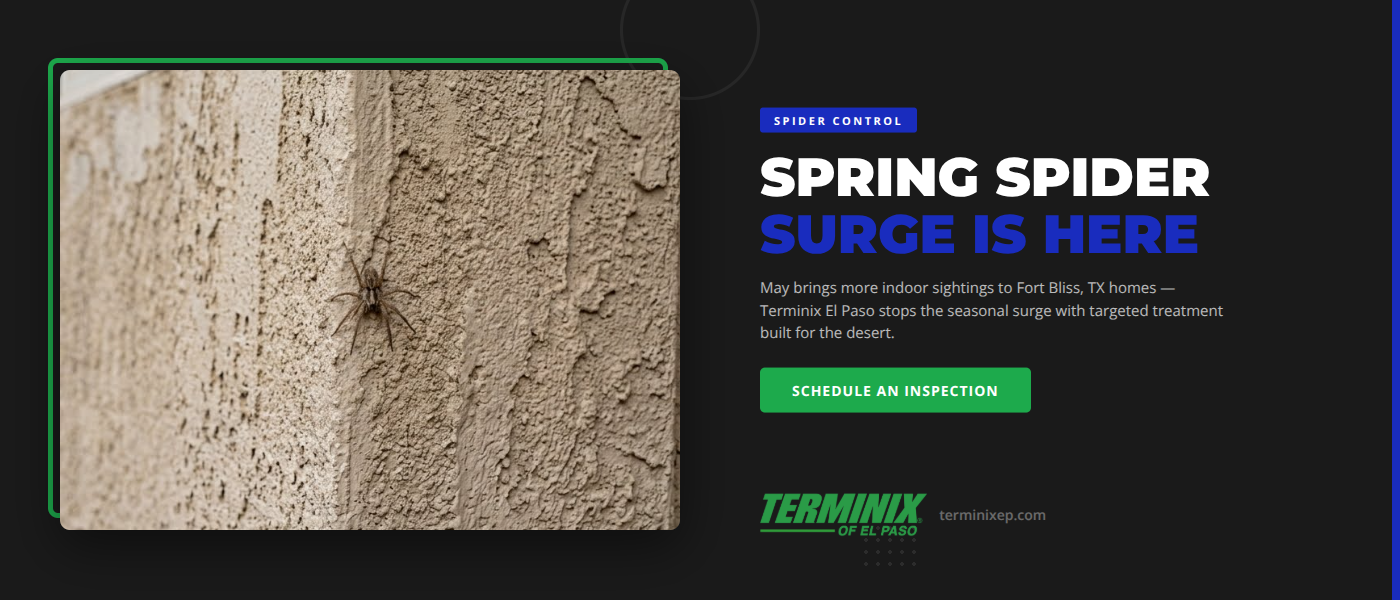
If you've started spotting more spiders in corners, garages, and under furniture this month, you're not imagining it — Fort Bliss homes are seeing the same surge from base housing out to the surrounding neighborhoods. May is when our phones light up with calls about spider control in Fort Bliss, TX, and the reason traces back to a desert pattern most homeowners never connect to indoor sightings.
At Terminix El Paso, we work with families and military households across the Fort Bliss area every spring, and we've watched the same surge play out year after year. Below we'll explain why May spikes spider activity here, which species end up indoors, the entry points to inspect first, the outdoor habits that pile on the pressure, and how our team handles the recurring activity store-bought sprays never seem to fix.
Spider activity follows the same seasonal arc as the insects they hunt. As daytime highs in the Fort Bliss area climb into the upper 80s and overnight lows settle in the 60s, the small flies, gnats, moths, beetles, and crickets that spiders feed on explode in number. More prey outdoors means more spiders maturing, breeding, and dispersing — and a percentage of that population always ends up indoors.
May also marks the end of the cool-night dormancy that kept many spider species hidden through late winter. Females that overwintered in garages, sheds, and crawlspaces become active again, lay egg sacs, and start hunting in earnest. By mid-May we typically see a noticeable jump in service calls across base housing on Fort Bliss, the surrounding subdivisions in Northeast El Paso, and the homes east toward Horizon City. The spiders aren't moving in suddenly — they were already nearby. Warm weather just made them visible.
Not every spider is a problem, but a few species in our area deserve respect. According to Texas Parks & Wildlife, the only two spiders considered medically significant statewide are the black widow and the brown recluse — and both are well-established across the El Paso region.
The two we recommend taking seriously — black widow and brown recluse — both favor the kind of low-traffic storage zones that exist in nearly every home. That's why our inspections start in those exact areas.
Fort Bliss sits in one of the more dramatic temperature-swing zones in the country. A May afternoon at 92°F can drop to 58°F overnight, and a single thunderstorm cell can shift conditions another 15 degrees in an hour. Spiders are cold-blooded, and they move toward whatever microclimate is most stable. In late spring, that often means inside our homes.
Air-conditioned interiors hold a steady 72 to 78°F all day. To a spider hunting prey along a foundation wall, an open patio door, garage gap, or weep hole behind landscape rock leads directly to ideal hunting conditions — moderate temperatures, plenty of crevices, and a steady stream of small insects drawn to indoor lighting at night. The bigger the daily temperature swing outside, the stronger the indoor pull becomes.
Drought stress amplifies the effect. Dry exterior soil pushes prey insects toward the moisture pockets near foundations and irrigation lines, and the spiders follow the food. Once they cross the threshold of an exterior wall, they tend to stay — finding harborage in storage boxes, wall voids, and the cluttered corners of rooms that don't see weekly cleaning.
Most of the spiders we collect during inspections came in through a handful of predictable entry points. Walk your property with a flashlight before sunset and you'll usually find at least three of these:
Sealing these openings does more than block spiders. It cuts the steady flow of crickets, beetles, and other prey that pulled them in to begin with — which makes every other piece of spider control work better.
The spiders inside your home almost always come from a population already living outside it. Reducing outdoor pressure shrinks the indoor problem:
These habits won't eliminate spiders entirely — nothing does in a desert ecosystem — but they cut indoor sightings substantially when paired with the entry-point fixes above.
DIY measures handle the casual orb weaver on the porch. They don't handle a recurring problem. If you're seeing webs rebuild within days of clearing them, finding multiple spiders inside the same room over a week, or spotting a black widow or brown recluse anywhere on the property, professional treatment is the right next step.
Households with kids, pets, elderly family members, or anyone with a known venom sensitivity have an extra reason to act early. Bites from medically significant species are uncommon, but the risk isn't worth taking when treatment is straightforward. Military families on Fort Bliss who PCS into housing with existing harborage often inherit a problem they didn't create — that's another situation where one professional inspection saves a lot of time and worry.
Effective spider control in Fort Bliss, TX isn't a single spray. It's a layered approach that targets active spiders, removes the conditions drawing them in, and stays on a schedule that interrupts the breeding cycle.
Our process starts with a detailed inspection — exterior walls, garage interiors, attics, storage zones, and the perimeter landscape. We document every active web, harborage area, and entry point we find, then build a treatment plan around what's actually happening on your property. From there, we apply professional residual products to the foundation perimeter, eaves, and known harborage zones; remove visible webs and egg sacs by hand or with de-webbing tools; and treat interior crack-and-crevice zones in garages, basements, and storage areas where harmful species hide.
Recurring service every two to three months keeps the residual barrier intact through the seasons, and the same visit covers the other desert pests that travel the same routes — scorpion control, cricket control, and the general pest pressure that pushes them all indoors. With a 4.9-star rating across more than 240 reviews, our team serves Fort Bliss along with El Paso, Socorro, Horizon City, Canutillo, and Sunland Park.
Visit us online or contact us today to schedule your spider inspection. May activity ramps quickly, and the gap between a few sightings and a full-scale problem is usually a matter of weeks.
May combines three triggers in our climate — rising daytime temperatures, increased prey insect activity, and dramatic day-to-night temperature swings that drive spiders toward stable indoor microclimates. Most of the spiders showing up inside were already living near your foundation and just became more visible as conditions warmed.
Brown recluse spiders are tan to medium brown, about the size of a quarter including legs, with a distinct darker violin-shaped marking on the body section behind the eyes. They have six eyes arranged in three pairs rather than the eight most spiders display. If you're not certain, photograph it from a few feet away rather than handling it, and our technicians can confirm the species during an inspection.
The products we use are EPA-registered and applied by licensed technicians at label rates designed with families in mind. We ask homeowners to keep pets and children indoors during application and for a short re-entry window — typically until products dry, usually 30 minutes to an hour. After that, the home and yard are back to normal use.
Most Fort Bliss-area properties do well on a quarterly schedule, with optional touch-up visits in May and again in late summer when activity peaks. Homes with heavy harborage — large garages, outbuildings, or extensive landscape rock — sometimes need bi-monthly service through the warm season to keep populations down.
Yes — Fort Bliss and the surrounding neighborhoods are part of our regular service area, alongside El Paso, Socorro, Horizon City, Canutillo, and Sunland Park. Contact us to schedule your spider inspection today.
 Mon – Fri: 8:00 am – 5:00 pm


