

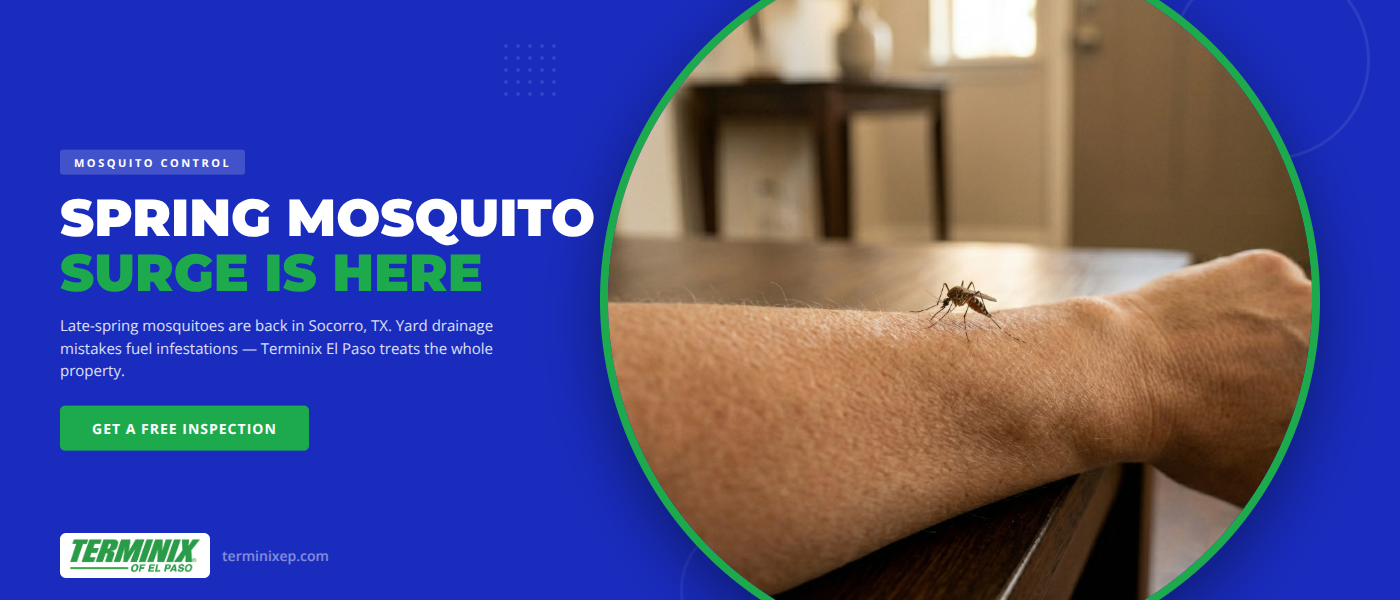
Spring is barely underway and the bites are already showing up. If you've stepped into your yard at dusk and felt a familiar buzz around your ankles, you're not imagining things — and you're not alone. Across the Lower Valley, calls about mosquito control in Socorro, TX are climbing earlier each year, and the reason almost always traces back to one issue most homeowners never think about: yard drainage.
At Terminix El Paso, we've spent years inspecting properties from Horizon City to Sunland Park, and the yards with the worst mosquito pressure aren't necessarily the ones near canals — they're the ones with small, repeating drainage mistakes that quietly create breeding habitat against the foundation. Below we'll cover why mosquito season is hitting Socorro earlier than it used to, which drainage mistakes drive the surge, the standing-water sources homeowners almost always miss, and how our team eliminates the problem at the source.
Mosquito season in low-elevation desert areas like El Paso County now begins in April, and warmer-than-average springs in recent years have pushed the first wave even earlier. Once daytime temperatures climb consistently into the 70s and overnight lows stay above 50°F, dormant eggs from last fall start hatching — and any standing water more than four days old becomes a functioning nursery.
Socorro sits on the eastern edge of the Rio Grande valley, where irrigation infrastructure, low-lying ag land, and clay-heavy soils all converge. Water doesn't drain through this soil quickly. After irrigation cycles, spring storms, or a backyard project that disturbs grading, water lingers for days — and that's all a mosquito needs. What used to be a June-through-September problem is now a March-through-October problem, and homeowners who used to schedule their first treatment around Memorial Day are calling us six weeks earlier than that.
Mosquitoes complete three of their four life stages in water. Eggs, larvae, and pupae all require standing water that sits long enough — usually 96 hours or more — for development to finish. That's the entire vulnerability point in their life cycle, and that's where good mosquito control in Socorro, TX has to start.
Drainage mistakes that create standing water aren't dramatic. They're the small, accumulated issues most homeowners never connect to bites:
Fixing the mosquitoes without fixing the drainage is a losing battle. You can fog the yard every two weeks, and within 96 hours of the next irrigation cycle, the same wet zones will be producing the next generation.
When we walk a Socorro property, we're looking for water that has been sitting for four or more days — and we find it almost everywhere. The sources homeowners are surprised to learn about include:
The rule we share with homeowners is simple: if you can find a tablespoon of water that's been sitting for four days, you've found a mosquito nursery. Multiply that by every dish, gutter, and divot on your property and the math gets uncomfortable fast.
Mosquito bites are more than an itchy nuisance in our region. West Nile virus has been a confirmed concern in El Paso County since 2003, and the City of El Paso Public Health Department continues to track active surveillance traps each season. The Department of State Health Services notes that residents living near irrigation canals — which describes a substantial portion of Socorro — should take extra steps to prevent bites because the surrounding habitat supports larger mosquito populations.
Most people who contract West Nile experience no symptoms, but roughly one in five develop fever, headache, body aches, and fatigue, and a small percentage develop neuroinvasive disease that can be life-threatening — particularly for people over 60 and those with weakened immune systems. Beyond disease risk, mosquito pressure makes outdoor living miserable: backyard barbecues end early, kids stop playing at dusk, and pet owners shorten evening walks. For families who invested in landscaping and patios, that's a real loss — and it's preventable.
Before you call anyone, there are practical steps every homeowner can take to cut mosquito pressure dramatically. None of these eliminate the problem on their own, but together they shrink the breeding population enough to make professional treatment far more effective:
For most Socorro yards, these steps cut visible mosquito activity by roughly half. They don't eliminate the population because surrounding properties and irrigation infrastructure keep producing new mosquitoes that fly in — that's where professional treatment closes the gap.
The aerosol cans on the hardware store shelf are formulated for general U.S. residential use — not for west Texas spring conditions. We see three repeating failures with over-the-counter products:
First, UV breakdown is brutal here. The same active ingredients that last three to four weeks in milder climates degrade in days under our intense desert sun. Professional formulations include UV stabilizers and microencapsulation that hold up far longer in our conditions.
Second, store-bought foggers don't reach where mosquitoes rest. Adults spend most of the day hiding in shaded vegetation — under shrubs, in tall grass, against fence lines. Surface fogging passes right over those resting zones, while professional barrier treatments are applied directly to vegetation with backpack misters that drive product into the canopy.
Third, most consumer products ignore the larvae. Treating standing water with larvicide — products containing Bti or methoprene that target larvae before they can fly — is the proactive piece most homeowners never get to. Without larvicide, every bit of missed standing water keeps producing the next wave.
If you're noticing daytime bites, can't enjoy your patio at dusk, or have already tried the hardware store route without lasting results, it's time to bring in our team. Effective mosquito control in Socorro, TX requires more than spraying — it requires identifying the specific breeding zones on your property, treating both adults and larvae, and timing applications correctly for our climate.
Our process starts with a property walk. We map standing-water sources, identify drainage issues that need attention, and locate the resting habitat where adult mosquitoes are spending their days. From there, we apply professional-grade barrier treatments to vegetation, treat any remaining standing water with targeted larvicides, and schedule recurring treatments through the season — typically every three to four weeks during peak activity.
With a 4.9-star rating across more than 240 reviews, our team serves the entire El Paso region, including Socorro, Horizon City, Canutillo, Sunland Park, and Fort Bliss. We also handle the other pests that come with desert spring — scorpion control, ant control, and spider control — when one inspection turns up more than just mosquitoes.
Visit us online or contact us today to schedule your mosquito inspection. Spring populations grow fast, and the gap between a manageable yard and an overrun one is usually only a few weeks.
Two factors drive earlier and heavier mosquito activity in our area: warmer-than-average springs that push the first hatch into March or early April, and Lower Valley soils that hold irrigation water long enough for breeding to occur. Properties near canals, irrigated farmland, or older neighborhoods with settled drainage tend to feel the surge first.
From egg to flying adult, the cycle takes about 7 to 10 days in spring temperatures and as little as 4 to 5 days at peak summer heat. That's why the standing-water reset rule we recommend is every four days — it interrupts the cycle before adults can emerge.
Yes. Mosquitoes do fly in from neighboring yards, easements, and irrigation infrastructure, but our barrier treatments and larvicide applications still dramatically reduce activity on the treated property. Recurring service handles the migrating population effectively, and we often recommend treatment timing that aligns with city fogging schedules for the strongest combined effect.
The products we use are EPA-registered and applied by licensed technicians at label rates designed with families in mind. We ask homeowners to keep pets and children indoors during application and for a short re-entry window after treatment — typically until products dry, usually 30 minutes to an hour. After that, the yard is back to normal use.
Yes — Socorro is one of the communities we cover regularly. Our service area includes El Paso, Socorro, Horizon City, Canutillo, Sunland Park, and Fort Bliss. Contact us to schedule your spring mosquito inspection today.
 Mon – Fri: 8:00 am – 5:00 pm


