

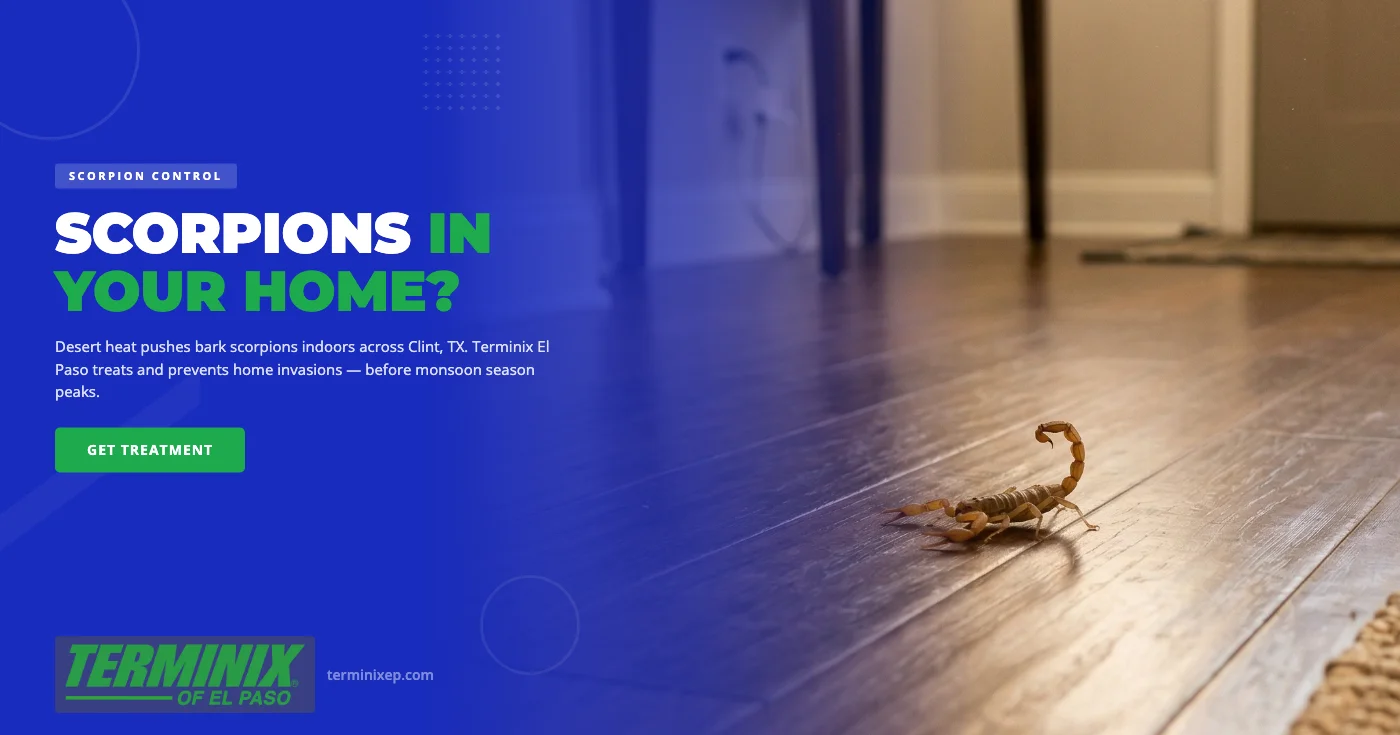
If you live in Clint, TX or anywhere in the lower El Paso Valley, scorpions are a fact of life — but the specific risks change with the season. July is consistently one of the highest-risk months for scorpion encounters inside homes in the far west Texas desert, and the reasons go beyond simply "it's hot outside." Understanding why scorpion pressure increases during peak summer helps homeowners in Clint take targeted preventive steps rather than reacting after a sting.
At Terminix El Paso, we provide professional scorpion control throughout Clint, TX, the Lower Valley, and the greater El Paso metro area. We've built our treatment approach around the specific conditions of the Chihuahuan Desert environment — including the bark scorpion populations that make this region one of the most scorpion-active areas in the United States.
Scorpions are temperature-sensitive predators that thrive in the Chihuahuan Desert's warm climate but face a genuine challenge when outdoor surface temperatures exceed 110°F — a common occurrence in Clint and the Lower Valley during July. At extreme surface temperatures, the desert floor becomes too hot for comfortable foraging, and scorpions naturally seek out cooler microenvironments.
Your home's air conditioning creates exactly the temperature gradient scorpions are looking for. A single-story home in Clint with an interior maintained at 75°F is 35 or more degrees cooler than the outdoor soil surface on a peak summer afternoon. Scorpions sense this temperature differential and move toward cooler areas through gaps in the structure — under doors, through utility penetrations, around window frames, and through foundation cracks.
Water also drives scorpion movement in July. As the desert dries between monsoon events, scorpions range farther from their established territory to find moisture. Homes with any kind of moisture — irrigation systems, condensate drain lines, water heater areas, bathroom plumbing — provide an attractive resource that can draw scorpions in from considerable distances.
Population pressure is another factor. Scorpions born in the spring mature over the summer and begin dispersing from birth sites, increasing the total number of scorpions in active circulation throughout the Lower Valley in July and August.
The Chihuahuan Desert supports multiple scorpion species, but one — the Arizona bark scorpion (Centruroides sculpturatus) — is the species responsible for medically significant stings in the El Paso and far west Texas region. Understanding what makes the bark scorpion different from other local species matters for both treatment and response if a sting occurs.
The bark scorpion is smaller and lighter in color than the more commonly depicted "desert scorpion" — typically 2.5 to 3 inches long, pale yellow to light brown, with a thin tail and slender body. Its small size makes it harder to detect in the typical hiding spots it favors: inside shoes, in folded clothing, inside cardboard boxes, behind picture frames, and in the seams of bedding.
Unlike most scorpion species that shelter in burrows under rocks or debris, the bark scorpion is a climber. It readily ascends walls, hides behind wall hangings and mirrors, and is found inside furniture more often than on the floor. This behavioral characteristic makes it particularly likely to be encountered indoors.
Bark scorpion venom contains a mixture of neurotoxins that cause significant pain, numbness, and tingling at the sting site and can cause more serious systemic symptoms — particularly in children, elderly individuals, and those with compromised immune systems. Anyone stung by a scorpion in the El Paso area should contact Poison Control immediately for guidance on appropriate response.
The weeks immediately preceding the monsoon season are consistently one of the peak periods for scorpion activity and human encounters in the Chihuahuan Desert region. This timing reflects several biological and environmental factors that converge in July.
By July, bark scorpion populations that overwintered under rocks, in wood piles, and in structural gaps have had four months of spring foraging. Young scorpions born in spring have grown and dispersed. The overall density of scorpions in Lower Valley landscapes is at or near its annual peak.
Dry conditions before the first monsoon rains force scorpions to forage more aggressively and range farther than during wetter periods. Desert invertebrates — crickets, cockroaches, and other arthropods that scorpions prey on — also concentrate around moisture sources like homes and landscaping, drawing scorpions closer to structures as they follow their food supply.
Evening temperatures in July remain high enough for scorpions to be active until late in the night, extending their active foraging window and increasing the likelihood of encounters during hours when residents are still awake and moving through their homes.
A professional scorpion inspection uses UV black lights, which cause scorpions to fluoresce — making them visible in darkness that would otherwise conceal them. During the day, scorpions shelter in specific locations that homeowners can also inspect.
Inside the home — Check inside shoes left on floors, particularly in closets. Inspect clothing left on chairs or floors before wearing. Pull away from walls any stored cardboard boxes. Check inside and behind furniture stored against exterior walls. Examine the underside of bathroom counter cabinets and the area beneath the washer and dryer. Scorpions are often found in drop ceilings and attic spaces as well, particularly in homes with attic storage or poor insulation at the top plate.
Outside the home — Bark scorpions shelter under any debris that provides cover and shade: rock landscaping, flagstone, stored lumber, firewood, and stepping stones. They also cluster in tight spaces like the space behind downspouts, under landscape boulders, and in cracks in block walls. Exterior lighting that attracts insects at night also attracts scorpions that follow their prey.
Entry points — Gaps under exterior doors (even small ones — scorpions compress their bodies significantly), utility penetrations through exterior walls, expansion joints in slabs, window weep holes, and gaps around HVAC lines are the most common entry routes. Door sweeps that aren't flush with the threshold are a particularly common problem.
Effective scorpion control requires treating both the interior harborage areas and the exterior zone around the home where scorpions forage and enter. A single interior application without exterior treatment addresses only part of the problem.
Terminix El Paso's scorpion treatment program for Clint and Lower Valley homes begins with a thorough inspection using UV black lights to locate active scorpions and identify high-concentration harborage areas. This inspection drives the treatment plan rather than applying products uniformly without location intelligence.
Exterior treatment targets the perimeter of the home, entry points, and exterior harborage areas using professional-grade insecticides. We address the zone 3 to 6 feet out from the foundation, around utility penetrations, and along the exterior wall surfaces where scorpions climb. Treating the exterior first reduces the pressure driving scorpions inside before they reach the structure.
Interior treatment focuses on cracks, crevices, and confirmed harborage locations — not broadcast application across living surfaces. We treat wall voids, behind appliances, under sinks, and in areas where scorpion evidence is found. Dust formulations applied to attic spaces and interior wall voids reach scorpions that shelter in those locations.
Physical exclusion recommendations accompany every scorpion treatment: replacing door sweeps, sealing utility penetrations, caulking foundation cracks, and adjusting exterior lighting to reduce insect attraction around the structure. These measures work in combination with insecticide application to produce lasting results.
July is one of the most important treatment windows for scorpion control in the Clint and Lower Valley area. Treating before monsoon rains arrive — rather than after — positions your home ahead of the population surge that follows the first significant rain events. Monsoon moisture activates dormant insects throughout the desert, increasing the food supply available to scorpions and spurring additional activity around structures.
If you're finding scorpions inside your home, seeing them regularly on exterior walls after dark, or discovering them in outdoor storage areas, contact Terminix El Paso for a professional inspection and treatment program tailored to your Clint property. Our technicians know the bark scorpion pressure specific to the Lower Valley and the structural characteristics common to homes in this area.
Learn more about our scorpion control services in Clint, TX and throughout the El Paso metro area.


