

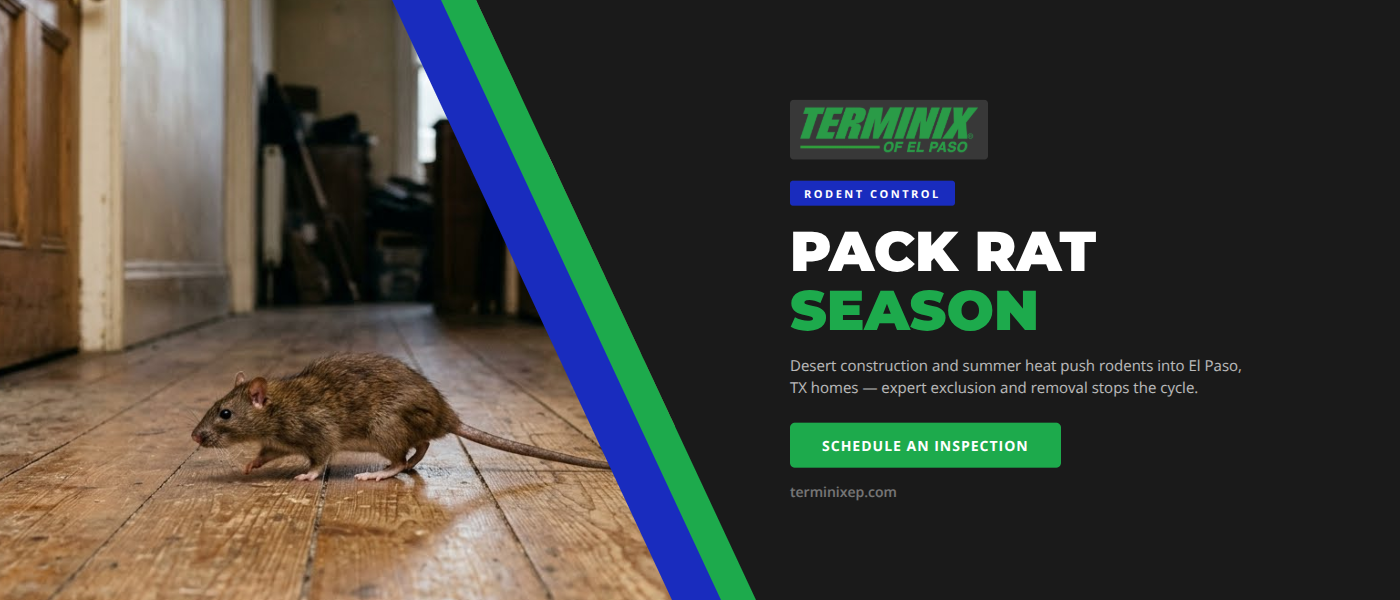
Late May is when rodent calls start climbing across El Paso, TX. The first 100-degree afternoons push pack rats out of the rocks and brush and into garages, attics, and engine bays — the same week roof rats start showing up along citrus trees, block walls, and irrigation lines in the older neighborhoods. By July, most of our route sheets are split between the two. Effective rodent control in El Paso, TX comes down to telling the species apart, finding the entry route, and closing it before the next litter arrives.
At Terminix El Paso we cover homes from the West Side and Upper Valley out through Horizon City, Socorro, Canutillo, Fort Bliss, and Sunland Park. The pattern repeats every summer: heat, drought, and new construction at the city's edges drive desert rodents into the closest source of water, shade, and cover — almost always a house. Below: why the surge happens, how to tell a pack rat from a roof rat, the entry points that matter, the health risks worth taking seriously, and why traps alone rarely end an infestation.
Pack rats and roof rats are not seasonal the way mosquitoes are. They breed year-round in El Paso, with females producing two to five litters per year and three to eight pups per litter. What shifts seasonally is where they live. As soon as daytime temperatures cross 95°F and overnight lows stay above 70°F, two things happen: food and water in open desert dry up, and structures with shade, AC condensation, and irrigation start to look like obvious targets.
That timing lines up with Memorial Day weekend in El Paso. By the second week of June we are typically running double the rodent calls we ran in March. Homeowners usually call after hearing scratching in the attic at night, finding chewed wiring on a vehicle, or spotting a stick-and-cholla pile against a block wall — that pile is a pack rat midden, and the rat is almost always nesting nearby.
The two species we deal with most in El Paso behave very differently, and matching the treatment to the species is what makes professional rodent control in El Paso, TX actually work. Fastest way to tell them apart: the tail.
One more practical difference: pack rats hoard. They drag shiny objects, bottle caps, screws, kibble, and bits of cactus back to the midden. Roof rats do not. A pile of small objects in an attic corner is almost always a pack rat. Smooth, greasy runways along a fence top or rafter are a roof rat.
El Paso is not growing at the center — it is spreading outward. Far East El Paso, Horizon City, the Northeast, and the Westside all keep pushing development into what was open desert five or ten years ago. Every new subdivision off Eastlake, Pebble Hills, or Resler displaces a resident pack rat population from the cholla and creosote. Those rats do not vanish — they look for the next nearest cover, and a new-construction home with stacked lumber, open weep holes, and fresh irrigation is exactly that.
The same dynamic plays out smaller. A neighbor pulls an overgrown yard, a city crew clears a drainage easement, a vacant lot gets graded — within weeks the rodents nesting there relocate into nearby garages, sheds, and roof spaces. We see a measurable spike in calls within a quarter-mile of any major lot clearing during summer.
Rats do not need much. A pack rat fits through a hole the size of a quarter; a juvenile roof rat fits through a dime. The University of Arizona Cooperative Extension's field guide on roof rats documents entry through openings as small as half an inch. After hundreds of inspections across El Paso County, these are the five entry points we find most often:
Until each is sealed with material rats cannot chew through — steel mesh, sheet metal, or cured concrete — trapping the rats already inside only opens a vacancy for the next one.
Pack rats and roof rats are not just a property problem. The Centers for Disease Control and Prevention reports that hantavirus pulmonary syndrome, while rare, carries a roughly 38% mortality rate in confirmed U.S. cases — and the desert Southwest is its primary range. The virus is most often tied to deer mice, but pack rat populations in the same habitat can host related hantaviruses. The transmission route is the same: breathing in particles from dried urine, droppings, or nesting material when an unprotected space is disturbed.
Beyond hantavirus, both species carry salmonella, leptospirosis, and rat-bite fever risks, and both shelter fleas, ticks, and mites that move readily onto pets. Then there is fire risk. Insurance adjusters in the Southwest consistently identify rodent-chewed wiring as a leading cause of attic and vehicle fires. The chewing is not malicious — rats' incisors grow continuously, and they file them down on whatever is available: low-voltage wiring, irrigation tubing, and dryer-vent ducting.
We get this call constantly: a homeowner has been catching a rat or two every week for a month with snap traps, and the activity is not slowing down. The reason is almost always the same — the traps are killing the rats that find them, but the population is refilling from outside faster than the traps can catch it.
Three structural reasons over-the-counter rodent control falls short:
Consumer rodenticides also carry a secondary-poisoning risk. Anticoagulant baits that kill a rat slowly are lethal to the hawks, owls, and pets that scavenge or hunt the weakened rodent. Tamper-resistant stations and a sequenced bait rotation matter — the regulated approach our technicians use, not the open-pellet products on store shelves.
Our approach to rodent control in El Paso, TX runs on a four-step protocol — the same sequence whether we are working a Mission Hills bungalow with a roof rat problem or a new build off Eastlake with pack rats in the engine bay. The U.S. Environmental Protection Agency's rodenticide rules give us a defined toolkit; how we deploy it is where local experience matters.
For homes with mature citrus, palms, or block walls overgrown with bougainvillea or oleander, we add a sanitation plan. Without addressing the vegetation, even a textbook exclusion can fail within a season.
Are pack rats and roof rats dangerous? Both species carry pathogens that can sicken people and pets — hantavirus, salmonella, leptospirosis, and the fleas and mites they shelter. They also gnaw wiring, which the insurance industry flags as a leading cause of attic fires. Damage and disease exposure together make professional removal the right call once activity is confirmed.
How fast do these populations grow? A single pair of roof rats can produce 40 or more descendants in a year under desert conditions. Pack rats breed slightly slower but live longer in undisturbed nests. Either way, the gap between a "one rat" call and a multi-room infestation is usually six to ten weeks.
Will sealing entry points trap rats inside the home? Not when the work is sequenced correctly. We inspect for active interior populations first, install interior traps before closing the last exterior opening, and confirm removal before sealing the final point. Done out of order, exclusion can trap rats inside — which is why DIY exclusion sometimes backfires.
Do I need ongoing service after the rats are gone? Quarterly exterior monitoring is standard for El Paso properties near desert open space, drainage easements, mature citrus, or recent new construction. Exclusion does the heavy work, but pressure from the surrounding habitat does not go away — monitoring catches the next attempt before it becomes a nest.
How long does a typical rodent control job take? From first inspection to confirmed resolution, expect three to six weeks for most homes. Properties with attic access, heavy yard clutter, or active vehicle damage can run a little longer.
If you are hearing scratching in the attic, finding chewed wiring in a vehicle, or noticing a stick-and-cactus pile against your house, the activity will not resolve on its own once the summer heat sets in. Schedule rodent control with Terminix of El Paso and we will inspect, identify the species, and build a sequenced exclusion-and-removal plan for desert conditions.


