

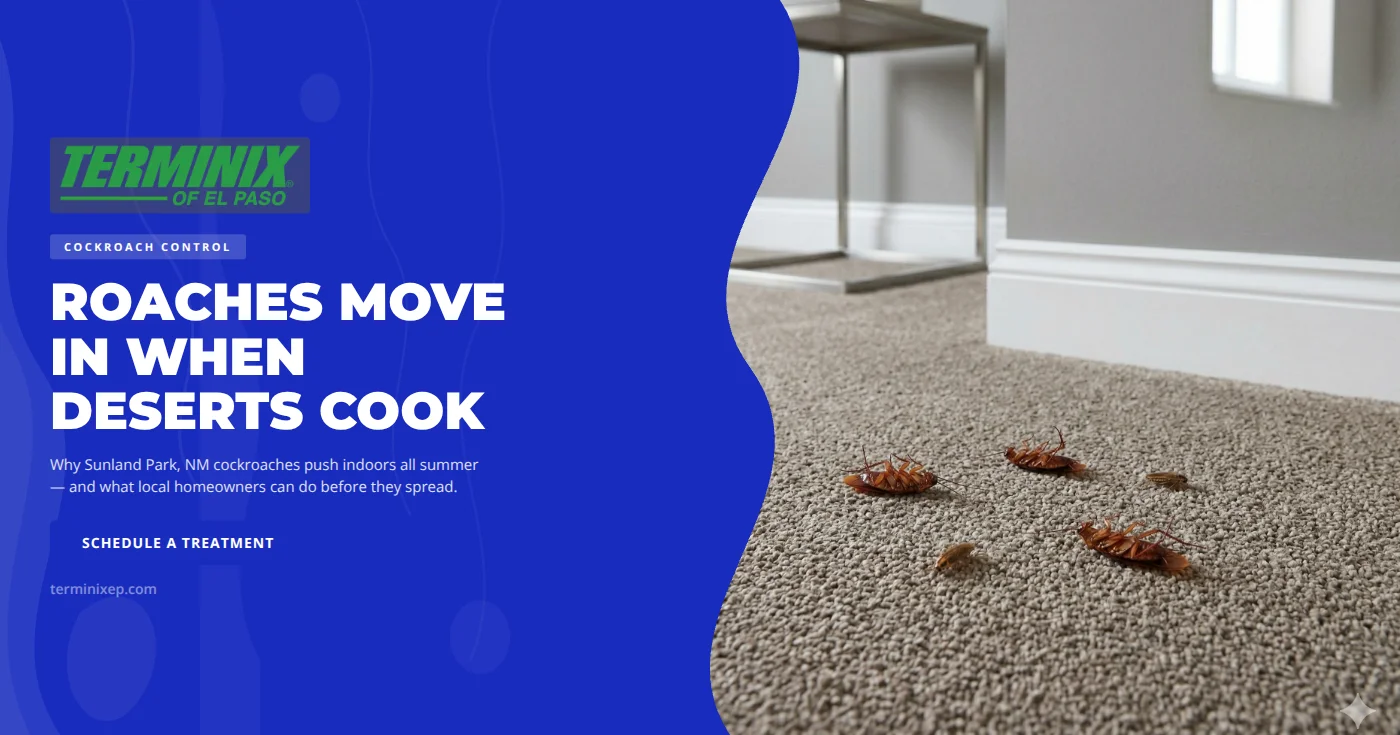
The first stretch of 100-degree afternoons across the border is when cockroach calls start climbing in Sunland Park, NM. The desert dries out, irrigation systems kick on, and roaches that spent spring in mulch, irrigation boxes, and block walls migrate toward the closest source of water and shade — almost always a house. By the second week of June our route sheets across Sunland Park and the El Paso metro are heavy with kitchen, garage, and laundry-room calls that were quiet a month earlier. Effective cockroach control in Sunland Park, NM starts with knowing which species you actually have, because the species drives almost every other decision.
At Terminix El Paso we cover homes from Sunland Park and Santa Teresa across the West Side, Upper Valley, Horizon City, Socorro, Canutillo, and Fort Bliss. The Chihuahuan Desert summer pattern repeats every year: extreme heat, sustained drought, and dense suburban irrigation push three or four cockroach species into structures at once. Below: why the surge happens, which species we identify most often, the warning signs worth acting on, why store-bought sprays rarely end the problem, the health risks that matter for households with children or asthma, and what a real treatment plan looks like in a desert climate.
Cockroaches are tropical insects living in a desert. They tolerate heat well, but not the dry air that comes with it. Once daytime temperatures in Sunland Park stay above 95°F and humidity drops into the single digits, a cockroach loses water through its cuticle faster than it can replace it — and has to either find moisture or die. Your kitchen sink trap, dishwasher base, the condensation pan under the fridge, the slow drip at a hose bib — all of it reads as a survivable microclimate.
The other half of the equation is irrigation. Sunland Park lawns and landscape strips get watered on overnight cycles through summer. That water collects in valve boxes, hollow block walls, and the seams under stucco — exactly the harborage Turkestan and American cockroaches prefer. Once a colony establishes outside a home, the gap between an outdoor population and an indoor sighting is usually a few hot nights and one open garage door.
Four species cover almost every call we run in Sunland Park. Identifying which one you have changes the treatment plan completely — what works on a German cockroach in a kitchen will not touch a Turkestan colony in the front yard.
The most useful information you can give a technician before an inspection is the roach's color and where you saw it — that alone narrows the species.
By the time most homeowners in Sunland Park call us, the population has been established for weeks. Cockroaches are nocturnal, so a single insect spotted in daylight usually means a larger group is sheltering nearby. These are the signs we treat as confirmed activity:
A Sunland Park homeowner sprays a hardware-store aerosol for a month, the roaches keep coming, and the can did not work the way the label suggested. The product killed some adults. The problem is what it did not do.
Professional treatment relies on bait formulations the roaches carry back to harborage, insect growth regulators that prevent the next generation from reproducing, and exclusion work that closes the entry points spray can never reach.
Cockroaches are not just a property nuisance — they are a documented respiratory trigger and a vector for several gastrointestinal pathogens. The strongest evidence concerns asthma. Research summarized by the National Institutes of Health shows cockroach allergens are one of the leading triggers of asthma attacks in children, with sensitization rates ranging from 17% to 41% in U.S. studies. The allergens come from droppings, shed skins, saliva, and decomposing roach bodies, and they persist in carpet, upholstery, and ductwork for months after the live insects are gone.
Beyond asthma, cockroaches mechanically transfer pathogens. They feed on garbage, sewer matter, and pet waste, then track the same residues across counters, dishes, and food packaging. Documented organisms include Salmonella, E. coli, and Staph aureus. For households with infants, immunocompromised members, or anyone with reactive airway disease, an established indoor cockroach population is a real exposure. Removing the roaches is only half the work; deep-cleaning the surfaces the colony contaminated is the other half, and one our technicians coach homeowners through after treatment.
A handful of consistent habits make the difference between a property cockroaches notice and one they pass by. None of these are expensive — most are sequencing the things you already do.
Two daylight sightings in a week, droppings in more than one room, or any sighting paired with the musty pheromone odor are the thresholds at which DIY stops being economical. The longer an infestation runs, the more expensive it is to resolve — population grows geometrically and the allergen load in soft surfaces compounds. Per New Mexico State University Cooperative Extension's IPM guidance, the recommended approach for established indoor populations is sanitation plus targeted treatment by a licensed applicator — not perimeter spraying.
Our protocol for cockroach control in Sunland Park, NM runs four stages:
For multi-family housing and commercial kitchens — which we also handle across the El Paso and Las Cruces service area — the protocol scales with monthly monitoring built in, since the re-introduction pressure from neighboring units never fully goes away.
How quickly can a cockroach population grow? A single German cockroach female can produce 200 to 400 offspring in her lifetime, with each ootheca releasing 30 to 40 nymphs that reach reproductive age in 60 to 100 days. Untreated, a handful of insects in May becomes a kitchen-wide problem by August.
Do cockroaches actually trigger asthma? Yes — and the link is well-documented. Cockroach allergen exposure is one of the leading indoor asthma triggers in children, and the allergens persist in dust and carpet for months after the live insects are gone. Households with reactive airway disease or young children should treat any confirmed cockroach activity as a priority.
Will one treatment end the problem? Rarely. Adult cockroaches die quickly from professional baits, but egg cases hatch on a two- to three-week cycle, which is why our protocol runs follow-up visits across roughly six weeks.
Are the products you use a concern for pets and children? The bait gels and IGRs we use are placed in cracks and voids pets and children cannot access. We brief homeowners on every product applied, where it was placed, and any re-entry interval before we leave.
How do I tell a cockroach from a desert beetle? Cockroaches have long threadlike antennae, flattened bodies, and spiny legs built for running. Beetles have hard wing covers that meet in a straight line down the back. If the antennae are longer than the body, it is a roach.
If you are seeing droppings, spotting roaches in daylight, or catching the musty odor in a kitchen or bathroom, the activity will not resolve on its own as summer settles in over Sunland Park. Schedule cockroach control with Terminix of El Paso and we will inspect, identify the species, and build a sequenced bait-and-exclusion plan for desert summer conditions.


