

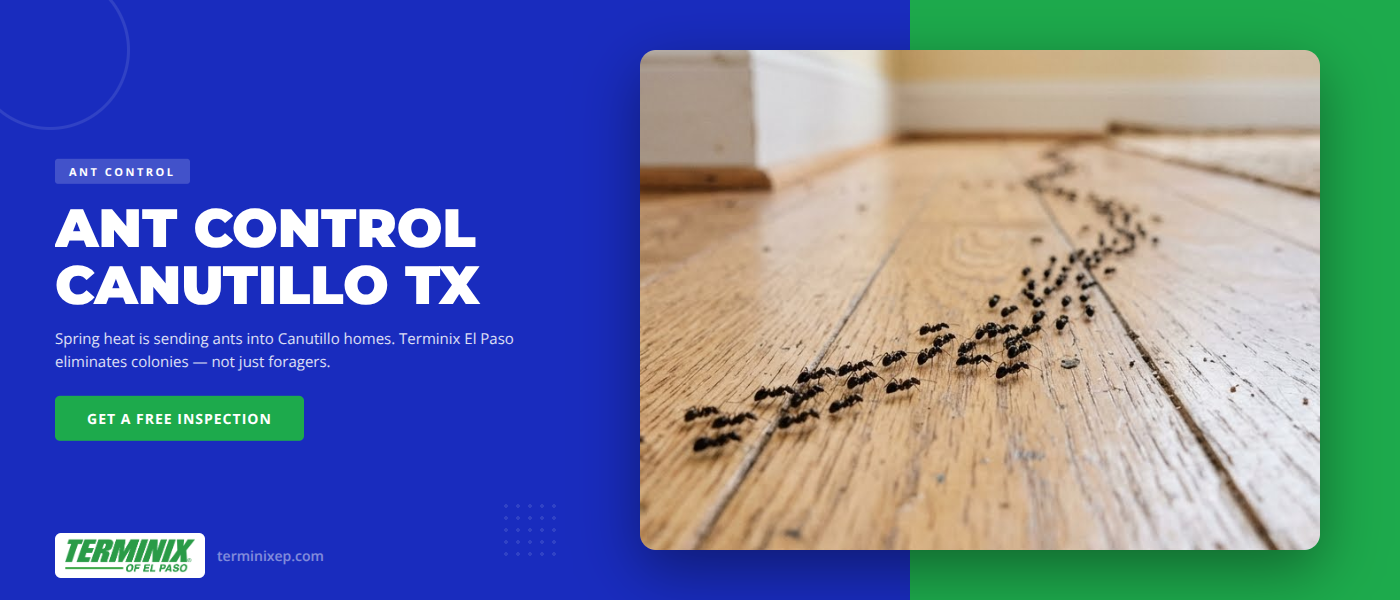
When spring temperatures start climbing in the El Paso borderland, ant control in Canutillo, TX becomes one of the most common calls we receive. The desert heat that defines our region also creates conditions that send ant colonies into overdrive — and straight into local homes. Understanding why this happens, and how to stop it, can save you a lot of frustration this season.
Canutillo sits in the fertile Rio Grande valley, where irrigated yards, agricultural land, and warm desert soils create an ideal environment for multiple ant species. When soil temperatures climb in early spring, dormant colonies wake up hungry and thirsty — and your home looks like a five-star buffet from their perspective. In this guide, we'll cover why spring heat drives ant infestations here, which species you're likely to encounter, how ants get inside, what damage they cause, and how Terminix El Paso eliminates the problem at its source.
Ant colonies don't disappear during winter in the desert southwest — they slow down and wait. Once soil temperatures climb above 50–60°F, queen ants begin laying eggs aggressively and workers fan out to forage. The colony needs to rebuild food stores and find water to support a rapidly growing population.
What makes this area particularly vulnerable is the combination of warming soil and irrigation. Many properties here rely on drip systems or flood irrigation, and those moisture zones attract ants from surrounding dry desert areas. As outdoor temperatures climb toward the 80s and 90s in April and May, ants actively seek cooler, climate-controlled environments — exactly what your home provides.
Spring also marks swarming season. Winged reproductive ants take flight to start new colonies. If you see flying ants inside or around your home in March or April, that's a strong signal a nearby colony is large and expanding. Our relatively mild winters mean ant colonies stay larger year-round, and spring activation happens earlier and more intensely here than in northern states.
Identifying the species you're dealing with helps determine the right treatment approach. In our area, we most commonly encounter these species:
Fire ants build large mound colonies in open, sunny areas. Their stings cause pain and can trigger allergic reactions. Colonies in west Texas often have multiple queens, making them extremely difficult to eliminate without professional treatment.
Harvester ants are native to the desert southwest and very common throughout the El Paso region. They prefer open, sandy soil and build large underground colonies. Their mounds can damage lawns and their bites deliver a painful sting.
Argentine ants form massive supercolonies that cooperate rather than compete, allowing populations to grow enormous. They're highly attracted to sweet foods and moisture, making kitchens and bathrooms prime targets inside any home.
Carpenter ants excavate wood to build nests. Finding them inside your home typically signals a moisture problem — they prefer wood softened by water damage. Left untreated, they can compromise structural integrity over time.
Named for the rotten coconut smell they emit when crushed, odorous house ants trail persistently along countertops and baseboards. They nest in wall voids and under flooring, with single colonies housing thousands of workers.
Homes in the area — especially older adobe, stucco, and wood-frame construction — offer numerous potential entry points. Here are the most common ones we find during inspections:
Sealing these entry points with silicone caulk, expanding foam, or steel mesh is one of the most effective preventive steps you can take before ant season peaks each spring.
Many homeowners underestimate how much damage an ant infestation causes when ignored. Carpenter ants hollow out galleries in wood beams and wall studs — their damage can be subtle but structurally significant, especially in homes with any history of moisture intrusion. Certain species are also attracted to heat from electrical wiring and can nest inside outlets and HVAC equipment, creating fire risks and causing equipment failure.
Food contamination is an immediate concern. Ants that travel through soil and decaying organic matter carry bacteria — including Salmonella — on their bodies, contaminating countertops and pantry items. Fire ant stings pose a real medical risk, particularly for children and elderly residents, as multiple stings can cause anaphylactic reactions requiring emergency care. In the yard, fire ant mounds can kill surrounding grass, damage plant roots, and make barefoot activity genuinely dangerous.
These preventive steps work best when applied before spring ant season gets fully underway:
The Chihuahuan Desert climate creates ant control challenges that are genuinely different from other regions. The sparse, dry desert surrounding our service area means any irrigated, shaded property becomes a concentrated destination for multiple competing colonies. Reinfestation after DIY treatment is nearly inevitable without a comprehensive perimeter strategy.
Desert ants also build their nests significantly deeper underground than species in wetter climates. Most over-the-counter mound drenches kill surface workers while leaving the queen and deep colony chambers untouched — the colony recovers within weeks. Many local fire ant colonies also have multiple queens, so eliminating one doesn't collapse the entire colony. Over-the-counter sprays also break down rapidly under intense desert sun, providing just days of residual protection rather than the weeks that professional-grade formulations deliver.
At Terminix El Paso, our approach to ant control in Canutillo, TX goes beyond surface treatment. We begin with a thorough inspection of both the interior and exterior of your home, identifying the specific species involved, locating entry points, and assessing the full scope of the infestation. Different species require different treatment approaches — what works against Argentine ants doesn't work against polygyne fire ant colonies with multiple queens.
We use targeted baiting, barrier treatments, and colony-contact products selected for effectiveness in desert conditions. Treatments are applied to the areas where ants are actually active — foundation lines, entry points, irrigation zones, and active foraging areas. We also identify conditions attracting ants to your property and provide recommendations to reduce long-term pressure.
With a 4.9-star rating and over 240 reviews, Terminix El Paso has earned the trust of homeowners throughout the El Paso region — including Canutillo, Socorro, Horizon City, and surrounding communities. Beyond ant control, our team also handles scorpion control, rodent control, and termite control for the full range of desert pest challenges. Visit us online or contact us today to schedule your ant inspection. Spring colonies grow fast — early treatment is significantly more effective than waiting.
Spring is the most active ant season in our area because rising soil temperatures trigger colonies to expand and forage aggressively. Ants that were semi-dormant through winter emerge hungry and looking for food and water. Your home's climate control, combined with kitchen food sources and plumbing moisture, makes it an attractive target right when colonies are at their most active.
Fire ants are reddish-brown and build dome-shaped mounds in open, sunny yard areas. The clearest sign is their aggressive swarming behavior — disturbing a mound even slightly causes workers to stream out and sting repeatedly. If you're unsure of the species, a professional inspection is the most reliable path. Correct identification matters because different species require different treatment strategies.
DIY approaches can reduce visible ant activity for small infestations. Sealing entry points, using bait stations, and eliminating food and moisture sources all help. However, established desert ant colonies — especially fire ant colonies with multiple queens — are very difficult to eliminate completely without professional-grade products and a full perimeter treatment strategy. Most homeowners who try DIY treatment for several weeks end up calling us anyway, usually after the infestation has grown larger.
Results vary by species and infestation size. Bait-based treatments typically take one to two weeks to fully collapse a colony as workers carry product back to the queen. Perimeter treatments provide immediate reduction of surface activity. Most of our customers see significant improvement within a week and full resolution within two to four weeks.
Yes — Canutillo is one of the communities we regularly serve. We cover the full El Paso area including Canutillo, Socorro, Horizon City, Sunland Park, Fort Bliss, and surrounding neighborhoods. Contact us to schedule your inspection today.
 Mon – Fri: 8:00 am – 5:00 pm


