

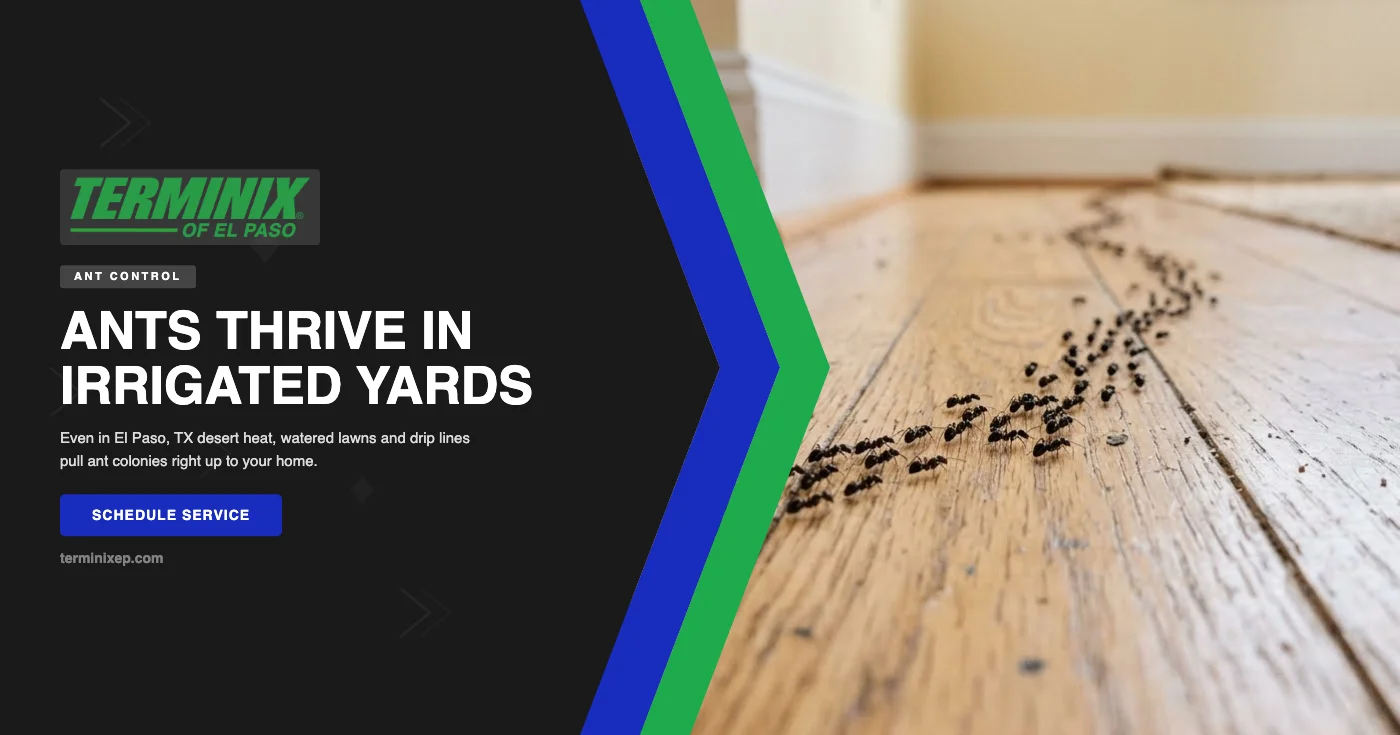
Ant complaints across El Paso, TX climb sharply once daytime highs lock above 95 degrees and irrigation systems shift into their nightly summer cycle. The Chihuahuan Desert around El Paso averages roughly nine inches of rain a year — far too little to support the dense colonies homeowners describe to us in June and July. Add an irrigated lawn, a few mulched beds, and a perimeter drip line, and the same lot reads to a foraging ant scout like a permanent oasis. Effective ant control in El Paso, TX starts with understanding why our watering habits matter more than our weather.
At Terminix El Paso we cover East and West Side El Paso, the Upper Valley, Socorro, Canutillo, Horizon City, Fort Bliss, and Sunland Park. The pattern is consistent: the heaviest ant calls come from the lush, well-watered yards on the block — not the driest unirrigated lots. Below: the species driving the calls, how watering and landscape choices sustain them, and why hardware-store spray usually makes the problem worse.
Native desert ants are built around scarcity. A typical El Paso lot watered three times a week through summer delivers the equivalent of 25 to 40 inches of rainfall a year directly to the root zone — four times what the surrounding desert receives. That single change rewrites the biology of the yard. Soil stays workable, organic matter accumulates in mulch and thatch, prey insects multiply, and ant species that could never establish on raw desert ground move in.
Research confirms the pattern. A study published in Environmental Entomology on ant diversity in irrigated desert parks documented significantly greater ant abundances in irrigated urban green space than in nearby desert habitat, plus a shift toward species typically found in cooler, wetter climates. Translated to an El Paso backyard: irrigation does not just attract more of the ants already here — it imports species that should not be able to live in the Chihuahuan Desert at all.
The species we identify most often on summer calls fall into a short list, and treatment varies by species.
Accurate ID drives the treatment plan. Bait that wipes out fire ants does almost nothing to rover ants, and a carpenter ant call is sometimes a moisture-damage call in disguise.
The same watering features that make an El Paso yard livable for people make it livable for ants. A few patterns drive most of the irrigated yard ant problems texas homeowners report.
By the time ants cross a kitchen counter at 7 a.m., the outdoor colony has usually been established for weeks. Earlier signals point to the problem before it crosses the threshold.
Where and when the ants show up tells a technician a lot. A 6 a.m. sighting on a backsplash points to a different nest location than a 9 p.m. patio trail.
A few targeted changes to how and where water is delivered remove most of the conditions ants depend on. None are expensive.
These summer ant prevention el paso adjustments add up fast. A yard that no longer holds moisture against the foundation, no longer feeds aphids on overwatered shrubs, and no longer shades mulch over damp drip lines is a yard where colonies struggle to stay established.
Most aerosol ant sprays sold at hardware stores are repellent contact insecticides. They kill the workers visible on the surface and leave a smell barrier that drives the colony away from the treated spot. That sounds like a win — until the colony does what it is built to do under stress: split. A fire ant or pavement ant colony sprayed repeatedly with a repellent often divides into smaller colonies that relocate around the yard. Within weeks the homeowner is seeing trails where it was quiet before.
The other failure mode is dose. A queen two to three feet underground in a network of chambers never contacts a perimeter aerosol applied to the slab. The colony absorbs the loss of a few hundred foragers and keeps producing replacements.
Effective treatment is built around the opposite chemistry. The Texas A&M AgriLife "Ants 101" program teaches the same baiting principles we use — slow-acting, non-repellent products that foraging workers carry back into the nest and feed to the queen and brood. The Two-Step method from the Fire Ant Project (broadcast bait plus targeted mound treatment) has consistently outperformed perimeter sprays in Texas urban-lawn studies for decades.
An el paso ant exterminator who quotes a single spray-and-leave visit is selling a temporary problem disguised as a solution. Our ant control el paso tx protocol is built around species, water, and structure together.
Our residential pest control program covers the quarterly side — the routine treatments and inspections that keep ant pressure down once the initial summer protocol has reset the colony.
Why are there so many ants in my el paso yard this summer? The combination of nightly irrigation, summer mulch beds, and 90-plus daytime highs creates exactly what ants need: moist soil, organic harborage, and abundant prey or honeydew. A yard that looked quiet in March can host two or three active colonies by mid-June.
Are fire ants really a problem in El Paso? Yes — increasingly so. Red imported fire ants have expanded into irrigated urban zones across Texas, and we now identify them in neighborhoods that did not have them five years ago. Fire ant landscaping desert conditions are not the natural habitat, but irrigated yards bridge the gap.
How to keep ants out of an irrigated lawn in texas? Water deeper and less often, pull emitters back from the foundation, replace mulch at the foundation with decomposed granite, treat aphid-covered shrubs, and fix leaky bibs or condensate lines. Those five changes remove the bulk of the moisture and food the colony depends on.
Why does my ant spray seem to make it worse? Repellent aerosols often cause colonies to split and relocate. The original trail disappears but new trails show up across the yard. Non-repellent bait, carried back into the nest by foragers, is what actually collapses the colony.
How long until I see fewer ants after professional treatment? Most homeowners notice a sharp drop in indoor trails within seven to ten days of the first bait. Full colony reduction typically takes two to three visits across the summer.
If you are seeing ants on countertops at first light, trails along a stucco wall, or fresh mounds along the driveway, the colonies will only grow more active as summer settles in over El Paso. Schedule ant control with Terminix of El Paso and we will identify the species, treat the colony with a non-repellent program built around the queen, and walk through the landscape changes that keep the next one from moving in behind it.


