

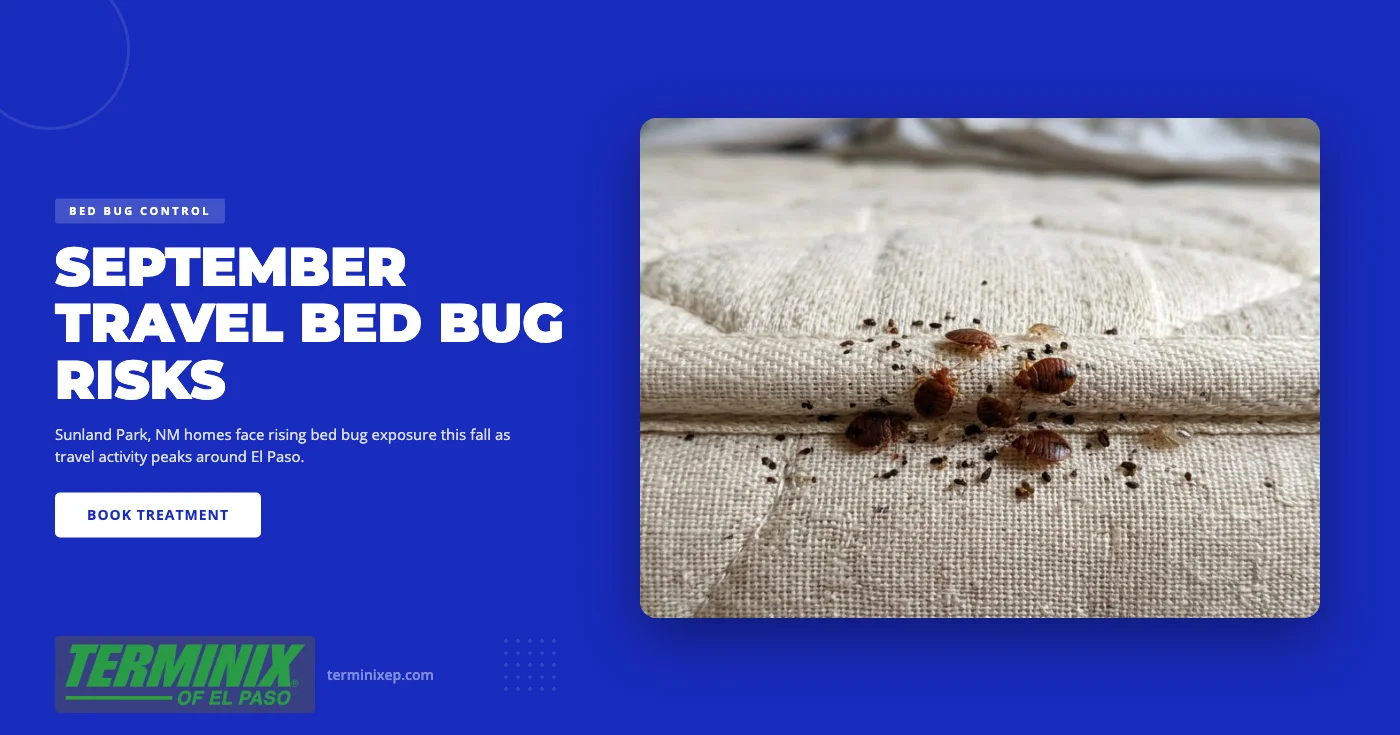
September doesn't feel like peak pest season in the high desert — but for bed bugs in Sunland Park, NM, it quietly is. Labor Day getaways, back-to-school family visits, September 16 travel through Santa Teresa, weekend trips to Sunland Park Racetrack, and the last hotel stays of the summer pack a lot of luggage into the final four weeks of the season. Every one of those bags is a potential ride into a bedroom. That's why calls for bed bug control in Sunland Park, NM climb sharply from mid-September through October, and why the smartest window to catch a hitchhiker is the three weeks right after you unpack.
At Terminix El Paso we serve homes across Sunland Park, El Paso, Socorro, Canutillo, Horizon City, and Fort Bliss. Below is what we tell every family who calls in September: why the travel calendar drives the fall spike, how bed bugs move through the border region, the early warning signs, where they hide, and what actually clears an infestation once one takes hold.
September is a hinge month for bed bug activity in the borderland. Two things converge. First, the travel calendar packs in almost every high-mobility event of the year — Labor Day weekend trips, the start of the school year and its parent visits, September 16 traffic through Santa Teresa, and the tail end of summer road trips. Every mile of that travel is a chance for a mattress seam somewhere else to hand a hitchhiker to a Sunland Park duffel bag.
Second, the desert climate hides the timeline. Bed bugs prefer indoor temperatures between 70 and 80 degrees — exactly what a Sunland Park air conditioner holds all September. A hitchhiker picked up during Labor Day travel doesn't just survive; it breeds on schedule. A female lays one to seven eggs per day, and those eggs hatch in six to ten days. When a founder population arrives during a September trip, the first bites usually don't appear until early-to-mid October. By then two generations have hatched, and what started as one bug in a rolling suitcase has become a mattress-seam colony.
That lag is why the calls we field in October so often start with, "It couldn't have been the trip." The math says otherwise.
Bed bugs don't fly and don't jump. Their only long-distance strategy is to wedge into a seam, a fold, or a cardboard corner and wait for that object to be moved somewhere new. September in Sunland Park is a busy month for exactly that kind of movement:
Bed bugs don't need a dirty environment — they need a previous occupant who unknowingly brought one in. Four-star hotels and roadside motels end up on our fall route sheets in equal measure.
If a hitchhiker made it home with you during a September trip, you usually have a three- to four-week window before the population becomes obvious. Catching it inside that window is the difference between a one-room job and a whole-home effort. What to watch for in the weeks after returning to your Sunland Park home:
If you find any of these signs after a September trip, don't start moving laundry, luggage, or bedding between rooms. That's the fastest way a contained problem turns into a multi-room infestation.
Sunland Park neighborhoods span a wide construction mix — older adobe-style homes near Doniphan, newer builds off McNutt Road, and rental duplexes near the racetrack. Regardless of the property age, bed bugs hide in the same predictable spots. When our technicians walk a bedroom during a post-travel inspection, we always check:
The pattern holds whether you're in an older Sunland Park build or a new construction near Ardovino's. The habitat that matters to a bed bug is the bedroom, not the neighborhood.
The impulse to handle a small problem yourself is understandable, especially when you first spot something suspicious. Most over-the-counter bed bug products fall short — not because the active ingredients are weak, but because bed bugs hide in places household sprays cannot reach and every life stage has to be handled at once.
First, contact sprays don't reach harborage. Bed bugs spend most of their lives tucked into seams, cracks, outlet gaps, and the underside of furniture. Spraying the visible mattress surface kills a few bugs out feeding and leaves the breeding population untouched.
Second, eggs resist most consumer products. The eggshell shrugs off many residual sprays — a treatment that knocks down adults still leaves a hatch wave coming a week later, and the cycle restarts.
Third, DIY foggers push bugs deeper into walls. Pyrethrin "bug bombs" rarely penetrate harborage. The chemical irritation drives survivors through wall voids into adjacent rooms, turning a one-bedroom problem into a three-bedroom one. The U.S. Environmental Protection Agency specifically cautions against relying on foggers as a bed bug solution for this reason.
Professional treatment closes those gaps: targeted heat reaches every life stage in one pass, residual products cover the harborage spots consumer sprays miss, and a two-week follow-up inspection confirms the treatment held.
Effective bed bug control in Sunland Park, NM almost always combines two tools: targeted heat and a residual chemical treatment. Each closes a gap the other can't.
Heat treatment raises the room temperature to roughly 120 to 135°F and holds it there for several hours. Every life stage dies at those temperatures, including eggs — which makes heat the only single-application method that handles a full bed bug population at once. Our team uses specialized heaters, high-volume fans to push heat into wall voids, and probes that confirm every corner reaches the lethal threshold.
Residual chemical treatment follows the heat, or runs alongside it in lighter infestations. We apply EPA-registered products to baseboards, mattress seams, box spring corners, and any crack where survivors could regroup. The residual film keeps working for weeks, catching strays that slip through the initial treatment.
Follow-up matters. Our standard plan includes a return inspection at the two-week mark to confirm the treatment held. That window also catches late arrivals from luggage or backpacks that hadn't been unpacked during the first visit.
With a 4.9-star rating across 240+ reviews, our team serves Sunland Park, El Paso, Socorro, Canutillo, Horizon City, and Fort Bliss. Visit Terminix of El Paso to schedule a post-travel inspection. Catching a fall infestation in the first month saves time, money, and household sleep.
Most families notice the first symptoms — usually bites, then dark spots on sheets — two to five weeks after returning. That matches the time it takes a founder population picked up during travel to lay eggs, hatch a generation, and grow visible. If you're inside that window and seeing unexplained bites, inspect your mattress and box spring and reach out to our team before the population expands.
Yes — and it's one of the more common inspection scenarios we see in Sunland Park every fall. Bed bugs don't care about ports of entry. If they were in a duffel bag or a rolling suitcase in a bedroom on either side of the line, they can end up in your bedroom in Sunland Park the same night. The fix is the same either way: inspect luggage in the garage or on hard flooring before it enters a bedroom, and launder travel clothes on high heat.
People, pets, and houseplants leave the home during a heat treatment because the elevated temperatures aren't comfortable inside. Once the home cools back to normal — typically four to six hours — your family returns without restriction. There are no residual chemical concerns from the heat itself.
That depends on how long the infestation has been active and whether luggage, laundry, or bedding has moved between rooms. In the first three to four weeks after a trip, single-room treatment is often sufficient. Beyond that window, our team inspects adjacent rooms and anywhere unpacking took place before recommending scope.
Yes — Sunland Park is one of the communities our team covers regularly. Our service area includes Sunland Park, El Paso, Socorro, Canutillo, Horizon City, and Fort Bliss. Schedule bed bug control in Sunland Park, NM with our team.
 Mon – Fri: 8:00 am – 5:00 pm


