

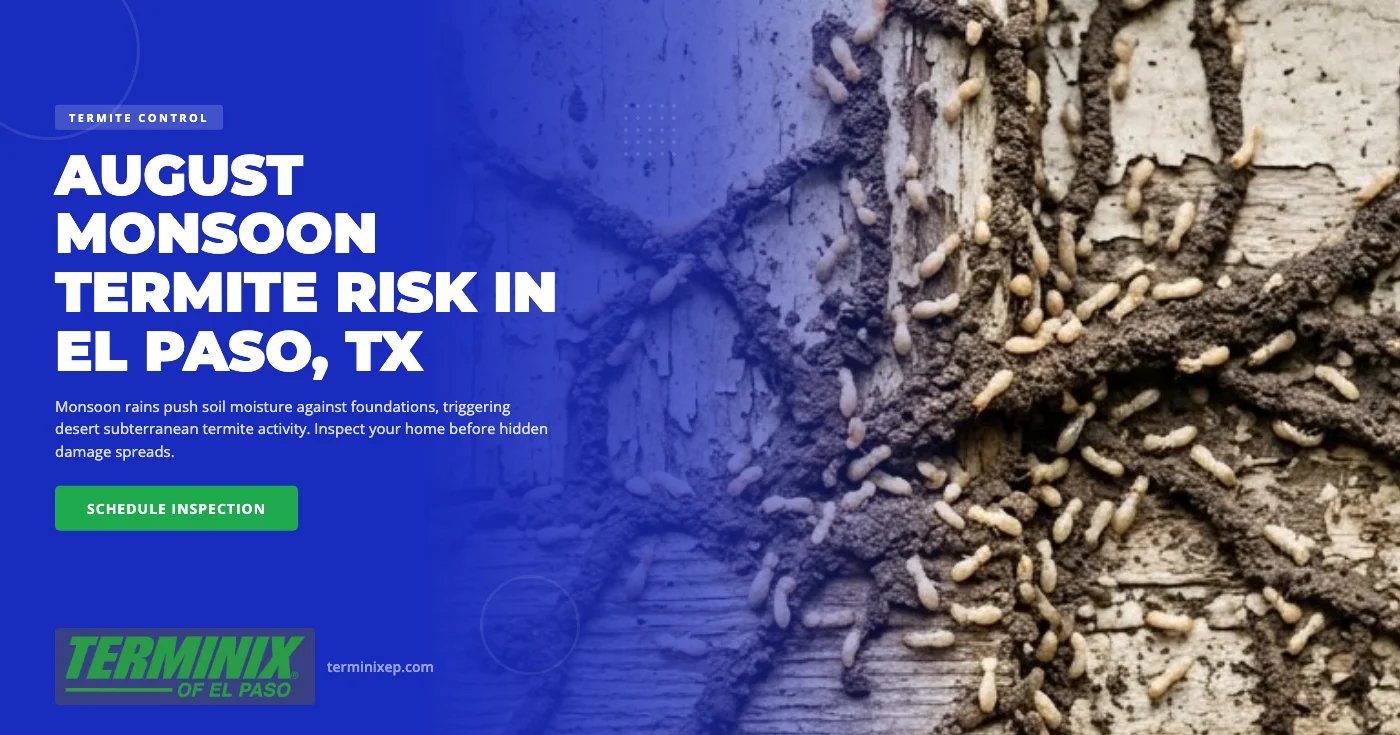
Every August we watch the same pattern across El Paso: afternoon thunderstorms drop an inch of rain, the air turns humid, and within days the termite calls start climbing. Monsoon moisture is the single biggest driver of visible termite activity here — August gives the desert subterranean colonies under our foundations everything they need at once: damp soil, warm nights, and the trigger to send winged swarmers looking for new wood. Professional termite control in El Paso, TX starts with understanding why late-summer rain accelerates damage often progressing quietly for months.
At Terminix El Paso we treat termites across El Paso, Socorro, Horizon City, Canutillo, Sunland Park, and Fort Bliss. Stucco-over-frame slabs, Lower Valley block-and-adobe, irrigation habits, and a high Rio Grande water table combine to make August termite pressure higher than the rest of the year.
El Paso averages roughly nine inches of precipitation a year, and about two thirds falls between mid-June and the end of September during the North American monsoon — August the largest single month. Two subterranean species matter here: the desert subterranean termite (Heterotermes aureus) and the arid-land subterranean termite (Reticulitermes tibialis). Both share the same requirement: every worker has to stay in contact with damp soil or die within hours.
From March through June, that constraint keeps foraging tunnels deep, often below four feet where winter moisture holds. When monsoon rain arrives the moisture line rises to within inches of the surface, foraging tubes follow it upward, and the soil against your slab or foundation stem wall becomes prime habitat. That is the mechanism behind el paso termite damage monsoon reports we see spike every August: the colony did not move in overnight, it moved up.
The second monsoon trigger is the reproductive flight. On warm, humid evenings after an afternoon storm, alate (winged) reproductives leave the colony in a synchronized swarm, rarely covering more than a hundred yards before shedding their wings and searching for a moist entry point. Piles of translucent wings on a porch or sill the morning after are almost always our first clue that a mature colony is nearby.
The homes we see infested most often after monsoon rain share a handful of features — some construction, some yard setup, some maintenance:
None of these are unusual around here — they describe how most El Paso yards and houses are set up.
Subterranean termites work quietly. Wood is hollowed from the inside, mud tubes hide behind stucco or landscaping rock, and most homeowners never see the colony until something breaks the surface. The days after a monsoon storm are the best window in the year to spot the signs:
Texas A&M AgriLife's field guidance on subterranean termite detection is clear that cracking a mud tube open with a screwdriver is the fastest confirmation — if pale worker termites are visible inside, the colony is active.
Subterranean termites do not eat stucco or adobe directly, but both materials shape how quickly a colony reaches structural wood. Stucco to grade is the most common concealed entry point in modern El Paso construction. The International Residential Code specifies a six-inch clearance between stucco and finished soil, but that detail is routinely missed at build or lost when a landscaping refresh raises the grade line. Once stucco touches soil, termites tunnel up the back of the finish inside the wall cavity and reach the wood plate at the top of the foundation without ever showing themselves.
Adobe adds a different vulnerability. Wood lintels, vigas, latillas, and bond beams sit inside a material that holds monsoon moisture longer than modern framing. When we inspect a Lower Valley adobe home, we map every wood penetration first — visual inspection alone will not catch a colony that moved through the adobe interior to reach a viga. Bottom plates, sill plates, and the first stud course at the slab edge fail first in either construction type; by the time a homeowner notices a soft baseboard, the wood behind it has often been compromised for months.
The highest-impact termite prevention around an El Paso home is landscape and moisture management. The goal is simple: keep the soil within three feet of the foundation as dry as possible, and eliminate wood-to-soil bridges.
None of these steps ends an active infestation — a colony already inside the wall needs targeted treatment. What they do is prevent the next colony from establishing, and extend the life of any treatment in place.
Termite inspection el paso texas requests climb every August for a reason: activity is at its most visible and swarming is at its peak. A monsoon-season inspection catches evidence that would be invisible in April and puts any treatment in motion before fall cooling drives the colony back underground. Several situations put an inspection on the calendar this month:
Our inspections are non-invasive and typically run 60 to 90 minutes on a single-family home. The deliverable is a written diagnosis: species identified, activity locations, moisture recommendations, and treatment options with cost. No treatment is required to receive the report.
Our termite treatment el paso tx work follows a four-step protocol adapted to whether the home is a modern stucco slab, a Lower Valley adobe, or new construction with pre-slab options. The regulated toolkit is reflected in Texas A&M AgriLife's subterranean termite management guidance; local adaptation is what makes a treatment hold in Chihuahuan Desert soil.
For homes under construction we also offer pre-slab soil treatment — the most cost-effective termite control an El Paso homeowner will ever buy, because it puts the treated zone exactly where a colony would have to cross.
Two subterranean species do the vast majority of structural damage here: the desert subterranean termite (Heterotermes aureus) and the arid-land subterranean termite (Reticulitermes tibialis). Both need soil moisture contact and build mud tubes. Drywood termite calls are rare but do happen — treatment plans and warning signs differ, which is why species confirmation is the first step of every inspection.
Modern non-repellent termiticides and in-ground bait stations are designed with families in mind. Liquid applications go into the soil along the foundation, and bait stations are sealed and tamper-resistant. We walk every homeowner through what was applied and any re-entry window before the technician leaves.
A properly installed non-repellent liquid termiticide barrier carries a manufacturer label of five to ten years in desert soil, with annual inspections confirming the barrier is intact. In-ground bait systems provide continuous protection as long as the stations are monitored.
Retail termiticides are surface contact products — they kill the foragers that touch them but do not reach the colony. The queen keeps producing replacement workers and visible activity slows for a few weeks before returning. Regulated non-repellent products available to licensed applicators do meaningfully more against established desert subterranean galleries.
If you have found discarded wings on a porch this monsoon season, spotted a mud tube on a foundation, or want a baseline inspection on a home that has never had one, reach out. We will give you a written diagnosis whether or not treatment is the right next step. Schedule a termite inspection with Terminix El Paso.
 Mon – Fri: 8:00 am – 5:00 pm


